

When You Need Water Extraction Services Fast: Start Here
Water extraction services remove standing water from your home or business after a flood, burst pipe, or leak — before it causes permanent damage.
If you’re dealing with water damage right now, here’s what matters most:
- Call a professional immediately — mold can start growing within 24–48 hours
- Shut off your water source if you can do so safely
- Turn off electricity to any affected areas
- Document everything with photos before anything is moved or cleaned
- Contact your insurance company within 24 hours of discovering the damage
Water spreads fast. It moves under baseboards, soaks into drywall, and saturates carpet pad within minutes. The longer it sits, the more it costs to fix.
The difference between a $2,000 repair and a $10,000 rebuild often comes down to how quickly extraction begins.
This guide lists 10 essential resources — tools, standards, services, and specialists — that every Denver-area property owner should know about when water damage strikes.
I’m Cole Nudel, a disaster restoration professional at A1 Water Damage Restorations in the Denver area, with hands-on experience helping homeowners and businesses navigate every stage of water extraction services — from the first emergency call to the final dry-out. Whether you’re dealing with a burst pipe at midnight or a slow leak that’s been hiding for weeks, the resources below will help you respond quickly and confidently.
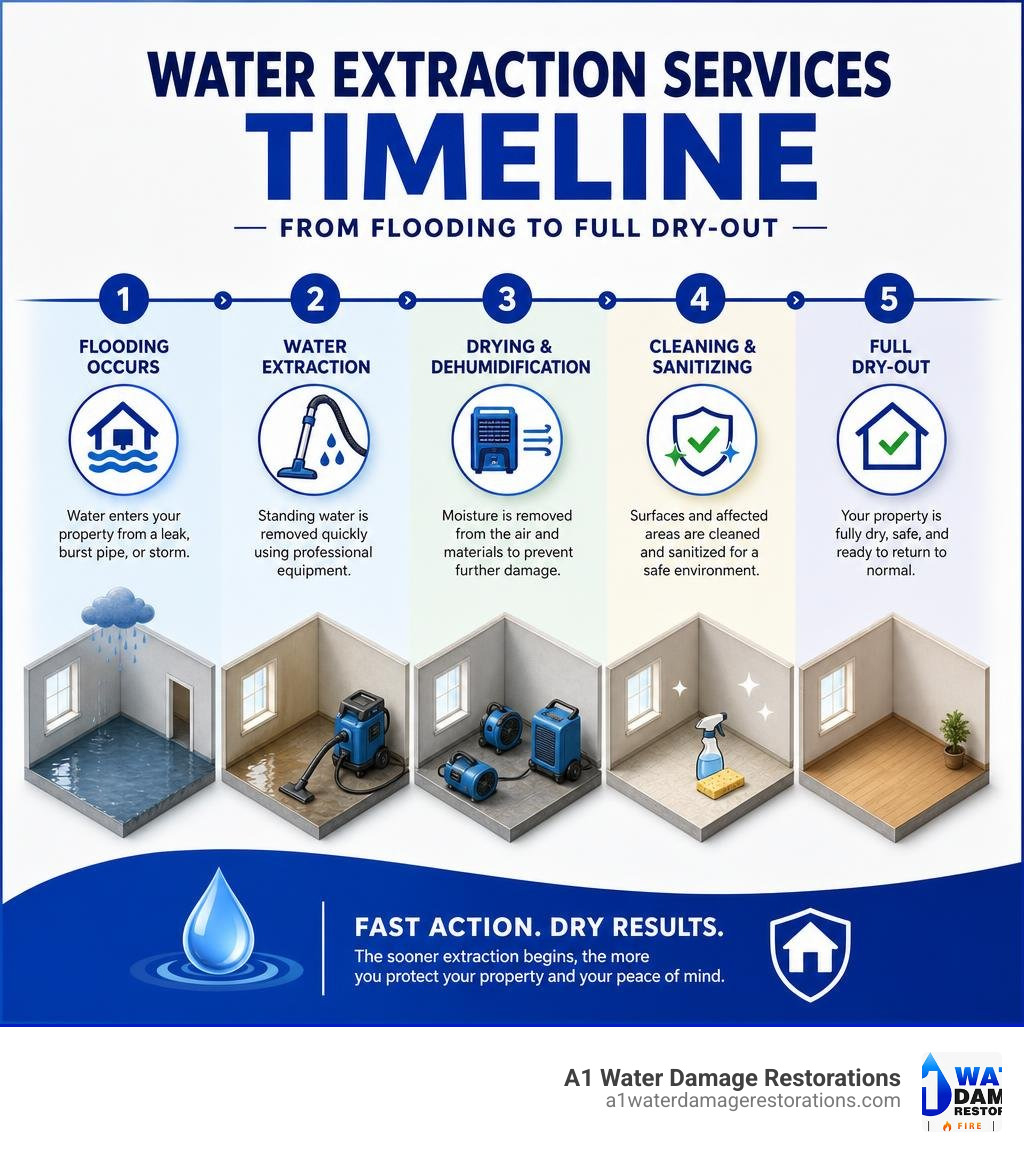
Understanding Professional Water Extraction Services
When water invades your property, it is easy to use terms like “extraction,” “drying,” and “restoration” interchangeably. However, in the professional restoration industry, these terms represent distinct, sequential phases of bringing your home back to life.
- Water Extraction: This is the physical removal of bulk, standing water from floors, carpets, and hard surfaces. Think of it as the heavy lifting. We use high-powered vacuums and submersible pumps to suck out hundreds or thousands of gallons of liquid.
- Drying and Dehumidification: Once the standing water is gone, the materials are still saturated. Drying involves using air movers and industrial dehumidifiers to evaporate moisture trapped inside drywall, wood flooring, and structural framing.
- Water Damage Restoration: This is the final umbrella phase. It includes reconstruction, painting, installing new carpet pad, mold remediation, and returning the property to its pre-loss condition.
Understanding this sequence is vital because trying to dry a room without extracting the bulk water first is like trying to blow-dry a soaking-wet towel fresh out of a swimming pool-it simply won’t work. For a deep dive into how these phases connect, you can read our guide on how to Don’t Let a Leak Sink Your Week with Professional Water Extraction.
To perform safe and effective water extraction services, professionals must also classify the water polluting your space. The Institute of Inspection, Cleaning and Restoration Certification (IICRC) defines three categories of water based on contamination levels:
- Category 1 (Clean Water): Originates from a sanitary source, like a broken water supply line or a malfunctioning faucet. While safe initially, Category 1 water can quickly degrade into Category 2 or 3 if left sitting in contact with building materials.
- Category 2 (Gray Water): Contains significant contamination and has the potential to cause discomfort or sickness if consumed or contacted. Examples include discharge from washing machines, dishwasher overflows, or toilet bowls containing urine but no feces.
- Category 3 (Black Water): Highly unsanitary and contains pathogenic, toxigenic, or other harmful agents. This includes sewage backups, rising floodwaters from rivers or streams, and wind-driven rain from storms. Category 3 water requires specialized personal protective equipment (PPE), rapid containment, and heavy-duty sanitization.
The Critical Timeline: When to Call for Emergency Help
When water enters your home, a silent, destructive clock starts ticking. Water behaves like an uninvited houseguest who doesn’t just overstay their welcome but immediately starts dismantling the furniture.
Within the first 15 minutes, water travels along the path of least resistance. It wicks up drywall (often climbing 6 to 12 inches above the visible water line in under an hour), seeps behind baseboards, and saturates the porous carpet pad underneath your rugs. If the leak is on an upper floor, it will find gaps in the subfloor and begin dripping through the ceiling assembly below.
Between 24 to 48 hours, the situation escalates dramatically. According to the EPA, mold spores—which are always naturally present in indoor air—germinate and begin colonizing damp surfaces within this window. Wood floors begin to cup and warp, drywall sags, and metal fixtures start to tarnish.
By the time 48 to 72 hours have passed, structural wood can swell and split, paint will bubble and peel off in sheets, and microbial activity rises sharply. What could have been solved with a quick extraction and structural drying now requires extensive demolition and mold remediation.
To help you decide when to roll up your sleeves and when to call in the cavalry, refer to this comparison table:
DIY vs. Professional Water Extraction
| Feature / Scenario | DIY Water Extraction | Professional Water Extraction Services |
|---|---|---|
| Best Suited For | Small spills under 100 sq. ft. of clean water (Category 1) on non-porous surfaces. | Any standing water, Category 2 or 3 water, basement flooding, or water affecting multiple rooms. |
| Equipment Used | Household towels, mops, standard wet/dry shop vacuums. | Truck-mounted extractors, submersible pumps, weighted extraction tools, thermal cameras. |
| Hidden Moisture | Missed entirely; moisture remains trapped behind baseboards and under subfloors. | Located precisely using FLIR infrared cameras and pinless moisture meters. |
| Mold Prevention | High risk of mold growth due to incomplete drying and lack of humidity control. | Guaranteed prevention via industrial dehumidifiers and EPA-registered antimicrobials. |
| Insurance Compliance | Often lacks the detailed moisture logs and photos required to approve claims. | Comprehensive documentation, moisture mapping, and direct adjuster coordination provided. |
Common culprits requiring immediate professional extraction include burst frozen pipes during Colorado’s sudden freeze-thaw cycles, sump pump failures during heavy spring snowmelt, and high-flow appliance failures. For example, a single residential fire sprinkler head discharges 15 to 25 gallons of water per minute—meaning a five-minute discharge can release up to 125 gallons of water directly into your living room.
For more tips on handling these fast-moving flood scenarios, check out The Ultimate Guide to Water Removal Services and Fast Flood Cleanup.
10 Essential Resources and Tools for Water Extraction
To successfully save a property from water damage, a “mitigation-first” approach is essential. This philosophy focuses on stabilizing the indoor environment, extracting water rapidly, and drying structural materials in place rather than immediately resorting to costly, disruptive demolition.
Achieving this requires a combination of advanced machinery, scientific standards, and local expertise. For an overview of how these elements work together, read Everything You Need to Know About Professional Water Damage Remediation Services.
Below are the 10 essential resources, tools, and standards used to perform professional water extraction services.
1. Truck-Mounted Water Extraction Services Equipment

The undisputed heavyweight champion of bulk water removal is the truck-mounted extraction unit. Powered directly by the truck’s engine, these systems utilize massive, high-capacity vacuum pumps that can pull water from a property at an astonishing rate of 500+ gallons per hour.
Unlike portable wet vacuums that must be constantly unplugged and emptied into a toilet or sink, a truck-mounted unit discharges water directly into an onboard waste tank or directly into a sanitary sewer line. This allows for continuous, uninterrupted extraction. The immense suction power also pulls moisture out of deep carpet fibers and subfloors far more effectively than any portable machine.
2. Submersible Pumps for High-Volume Extraction
When dealing with deep, standing water—such as a basement flooded with two feet of water due to a heavy storm or a major sewer backup—truck-mounted vacuums are preceded by submersible pumps. These heavy-duty pumps are designed to be completely submerged in water and can move between 2,000 and 3,000 gallons of water per hour.
They utilize gas or high-voltage electric power to rapidly pump out the bulk volume of the water through large-diameter hoses, clearing the way for technicians to bring in specialized extraction tools for detailed floor-level cleanup.
3. Weighted Extraction Tools for Carpets
When water saturates a carpeted room, the carpet pad underneath acts like a massive synthetic sponge. Simply running a vacuum wand over the top of the carpet only removes surface water, leaving the pad soaked and guaranteed to grow mold.
Enter the weighted extraction tool (often referred to as a “water claw” or ride-on extractor). These tools use the physical weight of the technician to compress the carpet and pad beneath them. As the pad is squeezed, the tool’s sealed suction chamber pulls water directly from the deepest layers. A weighted extraction tool can recover 80% to 90% of the water trapped in carpet and padding in a single pass, frequently allowing us to save carpets that would otherwise have to be torn out and thrown away.
4. Thermal Imaging and Moisture Mapping Technology
Water is an expert hiding specialist. It can seep behind drywall, pool in insulation, and sit quietly in wall cavities without leaving a single visible mark on the surface. To find this hidden moisture without tearing down your walls, we use FLIR (forward-looking infrared) thermal imaging cameras.
Because wet materials are cooled by evaporation, they show up as distinct dark, cold spots on an infrared screen. Once these cold zones are identified, we use pin and pinless moisture meters to measure the exact moisture content of the wood, drywall, or concrete. This allows us to create an accurate moisture map of the damage, ensuring we target our drying efforts exactly where they are needed.
5. Industrial Dehumidifiers and Air Movers
Once the standing water is extracted, the remaining moisture must be evaporated from the structural materials. We accomplish this using a coordinated system of high-velocity air movers and industrial-grade low-grain refrigerant (LGR) dehumidifiers.
Air movers blow high-speed air across wet surfaces, accelerating the rate of evaporation. However, all that evaporated water has to go somewhere; if left in the air, the relative humidity will skyrocket, and the drying process will stall. Industrial dehumidifiers pull this humid air in, super-cool it to condense and remove the moisture, and exhaust warm, dry air back into the room. This continuous cycle keeps the relative humidity low and pulls deep moisture out of porous structural wood.
6. EPA-Registered Antimicrobial Treatments
Water damage creates a breeding ground for bacteria, viruses, and fungi—especially if the water is Category 2 or 3. To protect the health of your family and ensure a safe indoor environment, we apply EPA-registered antimicrobial treatments and biocides to affected structural framing, concrete subfloors, and crawlspaces. These treatments sanitize the surfaces, kill existing mold spores, and leave a protective barrier that prevents new mold from colonizing while the structural drying process is underway.
7. IICRC S500 Standard Reference Guides
Professional restoration is a science, not a guessing game. The restoration industry is governed by the IICRC S500 Standard and Reference Guide for Professional Water Damage Restoration. This comprehensive document outlines strict, scientifically validated procedures for water extraction, drying timelines, category classifications, and safety protocols.
When you hire an IICRC-certified technician, you are hiring someone who has mastered these rigid guidelines, ensuring your home is dried safely, thoroughly, and to verifiable standards.
8. Homeowners Insurance Claim Documentation Checklists
Navigating an insurance claim during a water emergency can feel overwhelming. To ensure your claim is approved quickly and without friction, professional documentation is essential. Insurance adjusters look for clear, objective proof of the damage and the steps taken to mitigate it. A complete documentation package should include:
- Clear, timestamped photographs and video of the initial water intrusion
- Detailed moisture logs showing daily readings from affected materials
- Infrared thermal images showing hidden wet areas
- Equipment logs tracking the placement and runtime of air movers and dehumidifiers
By maintaining strict, transparent records, we make it easy for your insurance provider to see that the work was necessary, compliant with IICRC standards, and performed efficiently.
9. Local Emergency Water Extraction Services Providers
When water is actively flooding your home, you don’t have time to wait for a company dispatched from hours away. You need a local, family-owned provider with certified technicians who can arrive at your door in minutes.
At A1 Water Damage Restorations, we provide 24/7 emergency response throughout the Denver Metro Area, ensuring a swift arrival with fully equipped trucks. Whether you are up north in Boulder, in central Denver neighborhoods like Cherry Creek, on the west side in Arvada and Golden, or down in the southern suburbs of Greenwood Village and Littleton, our local teams are strategically stationed to respond immediately.
No matter where you live in our beautiful metro area, having a local specialist on standby is your best defense against water damage.
10. Professional Document and Paper Restoration Specialists
Water damage doesn’t just ruin floors and drywall; it also threatens precious family photos, historical documents, books, and vital business records. Fortunately, paper can be saved if treated quickly.
Specialized document restoration professionals utilize advanced techniques like vacuum freeze-drying (which sublimates frozen water directly into vapor, preventing paper fibers from swelling and bleeding) and desiccant air-drying to safely dry, deodorize, and restore water-damaged documents to a stable, usable state.
Step-by-Step: The Professional Water Extraction Process
So, what actually happens when a professional restoration crew arrives at your home? We don’t just walk in and start throwing hoses around. We follow a highly systematic, step-by-step process designed to maximize water recovery and keep your family safe.
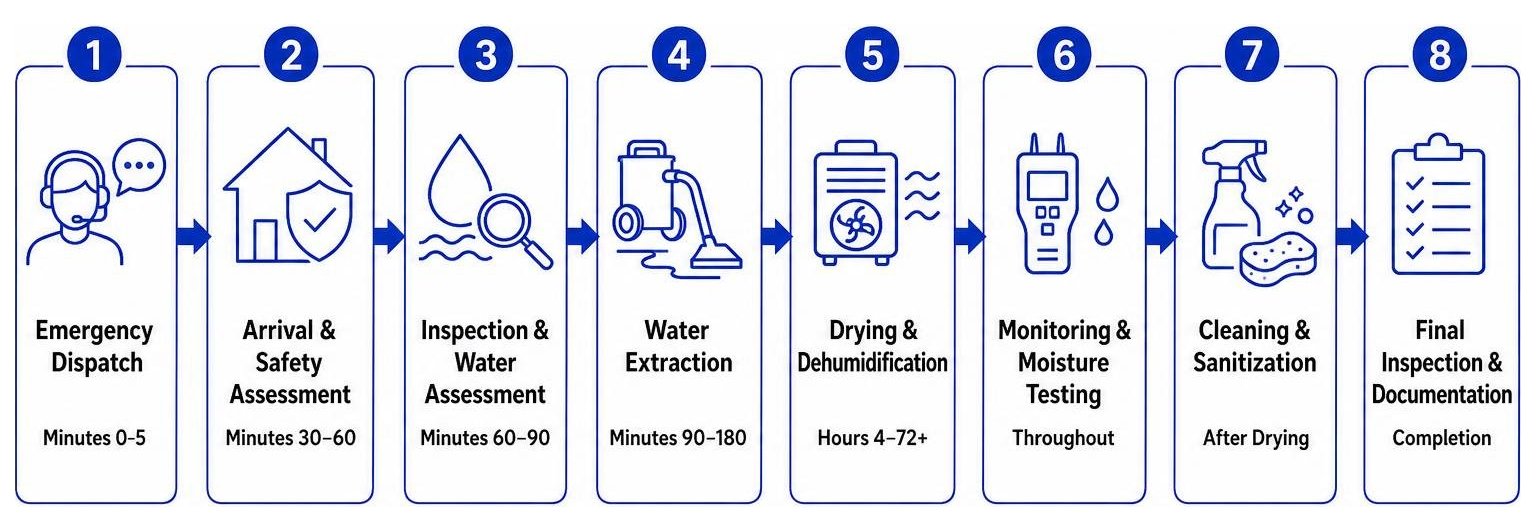
Step 1: Emergency Dispatch (Minutes 0–5)
The moment you call our emergency line, our dispatch team gathers key details: the source of the water, the number of affected rooms, and any immediate safety hazards. A certified local crew is immediately mobilized.
Step 2: Arrival and Safety Assessment (Minutes 30–60)
Upon arrival, our first priority is safety. We inspect the property for electrical hazards (ensuring water hasn’t reached outlets or breaker panels), check structural stability, and determine the category of water contamination.
Step 3: Source Containment
If the water source is still active—such as a burst pipe behind a wall—we locate the main shutoff valve and stop the flow of water immediately.
Step 4: Bulk Water Extraction
Using truck-mounted extractors and submersible pumps, we systematically extract standing water, working from the farthest points of the water migration back toward our main exit point.
Step 5: Detailed Surface Extraction
We use weighted extraction tools on carpets, specialized squeegee attachments on hardwood and tile, and portable extractors in tight spaces like closets and crawlspaces to remove every drop of liquid water possible.
Step 6: Moisture Mapping
We use infrared cameras and moisture meters to trace the exact path of the water, marking wet areas on a digital map and setting up baseline moisture readings for all affected structural materials.
Step 7: Initial Drying Equipment Setup
Based on our moisture map, we strategically place industrial air movers and LGR dehumidifiers to establish balanced drying conditions and begin pulling trapped moisture out of walls and floors.
Step 8: Documentation & Monitoring
We document the entire process with photos, compile our initial moisture readings, and set up a daily monitoring schedule to track the drying progress until the home is completely certified dry.
For a deeper look into what to expect during this process, read our comprehensive guide on Don’t Drown in Stress: What to Expect from Flood Drying Companies.
Frequently Asked Questions About Water Extraction
Dealing with water damage can raise a lot of questions. Here are clear, straightforward answers to the most common questions we hear from homeowners.
Does homeowners insurance cover water extraction?
In most cases, yes. Standard homeowners insurance policies typically cover water extraction services and drying if the water damage is caused by a sudden and accidental internal event, such as a burst pipe, water heater failure, or washing machine overflow.
However, standard policies almost always exclude damage caused by external flooding (such as rising rivers, heavy rain runoff, or storm surges)—this requires a separate flood insurance policy through the National Flood Insurance Program (NFIP). Additionally, damage resulting from long-term neglect or lack of maintenance (like a slow, visible pipe leak that was ignored for months) is generally denied.
Regardless of the source, always document the damage thoroughly and contact your insurance provider immediately to open a claim.
How long does the water extraction process take?
The physical water extraction phase—removing the standing, liquid water—usually takes anywhere from a few hours to a single day, depending on the size of the flooded area and the depth of the water.
However, the complete drying and structural stabilization phase that follows typically takes between 3 to 5 days. Denser materials, such as concrete subfloors, plaster walls, and hardwood floors, may take longer to dry completely. For a detailed breakdown of local Denver drying timelines and factors, read From Sump Pumps to Mold Slumps: A Guide to Denver Water Extraction.
Can I use a regular wet/dry vacuum for flood water?
While a standard household wet/dry shop vacuum is great for cleaning up minor spills (like a spilled bucket of water in the garage), it is not equipped to handle a true flood or water emergency.
Shop vacuums lack the suction lift required to pull water out of deep carpet padding or porous wood subfloors. Furthermore, they have very small tank capacities (usually 5 to 10 gallons), meaning you will have to stop, unplug, and empty the heavy tank every few minutes. Most importantly, a shop vacuum cannot address the high relative humidity left behind, leaving your home highly vulnerable to mold growth and hidden structural rot.
Conclusion
When water invades your home or business, every minute counts. Delaying extraction by even a few hours can turn a straightforward dry-out into a massive, expensive reconstruction project.
If you are facing water damage in the Denver Metro Area, you don’t have to navigate the stress alone. At A1 Water Damage Restorations, we are a family-owned, local business dedicated to protecting our community. Our IICRC-certified technicians are available 24/7/365 to respond to your emergency with state-of-the-art truck-mounted extractors, advanced moisture mapping technology, and a personal, caring touch. We handle everything from emergency bulk extraction to structural drying, sanitization, and final reconstruction, ensuring your property is restored better than ever.
Don’t let water damage define your home’s story. If you need immediate help or want to learn more about our comprehensive mitigation services, visit our Water Damage Restoration Services page or explore our full range of restoration Services today. We are here to bring the experience, urgency, and care your home deserves.