

When Property Reconstruction Services Are the Right Next Step
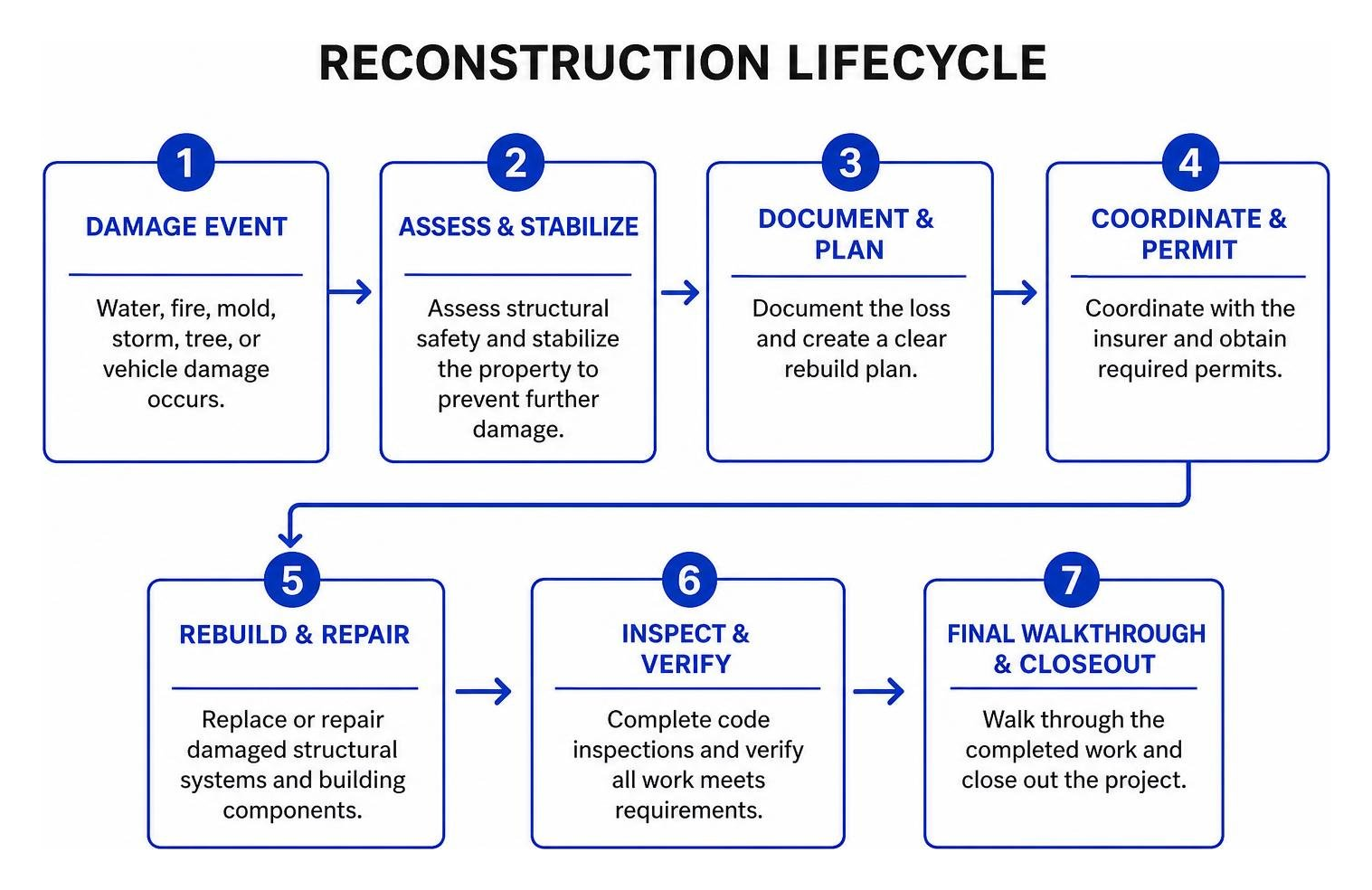
Property reconstruction services rebuild the parts of a home or business that cleaning and drying cannot save. After water, fire, mold, storm, tree, or vehicle damage, a qualified contractor should assess structural safety, document the loss, coordinate with the insurer, obtain permits, and manage repairs through the final walkthrough.
Reconstruction is different from restoration. Restoration focuses on stopping further damage, drying, cleaning, and salvaging materials. Reconstruction begins when damaged framing, drywall, flooring, roofing, electrical systems, plumbing, or other building components need replacement or major repair.
Fast action matters after water damage. Mold can begin colonizing within 24 hours, while structural materials may become saturated within 72 hours. The right team can stabilize the property first, then create a clear rebuild plan that protects your safety, budget, and insurance claim.
I am Cole Nudel, a disaster restoration professional with A1 Water Damage Restorations in the Denver area. I help property owners navigate property reconstruction services and the difficult decisions that follow unexpected property damage.
Understanding Property Reconstruction vs. Restoration
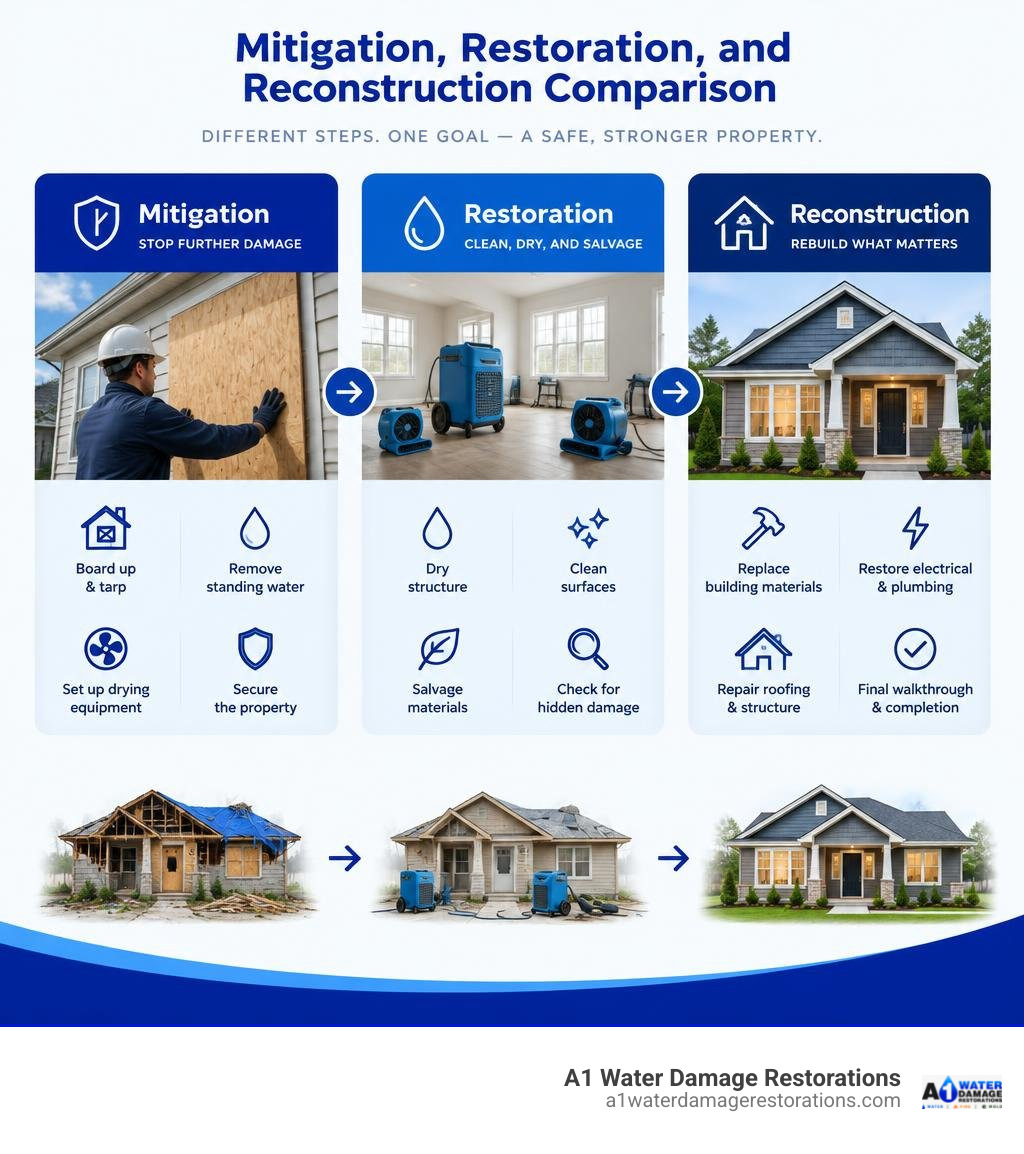
When disaster strikes a home or commercial building, property owners often hear terms like emergency mitigation, restoration, and reconstruction used interchangeably. While they are closely related phases of disaster recovery, each stage serves a distinct purpose in bringing a property back to life.
Understanding the transition from emergency response to structural rebuild is critical. Emergency mitigation focuses strictly on stopping active damage. This includes boarding up broken windows, placing roof tarps, performing emergency water extraction, and setting up industrial drying equipment like Low Grain Dehumidifiers (LGRs) and high-volume air movers.
Restoration focuses on cleaning, sanitizing, and preserving as many structural components and personal belongings as possible. Exploring a comprehensive restoration overview helps clarify how technicians use thermal imaging, moisture mapping, and controlled drying techniques to salvage framing or subfloors.
However, when building materials sustain permanent physical deterioration, full property reconstruction services become necessary. When drywall disintegrates from prolonged water saturation, charred load-bearing beams lose their structural integrity, or roof trusses buckle under snow or storm loads, simple cleaning is no longer an option. Reconstruction involves genuine general contracting: taking the stripped, sanitized shell of a building and physically rebuilding it to code.
| Phase | Primary Goal | Typical Actions | Equipment & Methods |
|---|---|---|---|
| Mitigation | Stop active damage and secure the property | Water extraction, board-up, roof tarping, safety shoring | Submersible pumps, containment barriers, LGR dehumidifiers |
| Restoration | Clean, sanitize, and salvage existing materials | Soot removal, mold remediation, odor neutralization | HEPA vacuums, air scrubbers, thermal foggers, moisture meters |
| Reconstruction | Rebuild destroyed structural elements | Framing, drywalling, rough carpentry, plumbing, electrical | General contracting trades, architectural planning, code inspections |
Common Causes Requiring Complete Rebuilding
Property owners rarely plan for structural rebuilding, but several catastrophic events force materials past the point of simple cleanup:
- Severe Water Intrusion: A burst pipe or severe plumbing rupture on an upper floor can cascade downward for hours. Mold can begin colonizing within 24 hours, and structural subflooring, joists, and drywall can fully saturate within 72 hours, resulting in sagging ceilings, rotted subfloors, and ruined structural studs.
- Fire and High-Heat Devastation: Navigating fire and water damage recovery involves addressing both structural charring and the vast amounts of water used to extinguish the blaze. High heat compromises roof trusses, while caustic smoke and soot penetrate deep into structural porous wood.
- Storm and Wind Damage: Violent windstorms, heavy hail, and severe snow loads can collapse roof sections, tear away exterior siding, or crack foundation walls.
- Vehicle Impact and Fallen Trees: When a car crashes into a storefront or an ancient tree crushes a living room ceiling, load-bearing walls shift instantly. This requires rapid emergency shoring followed by heavy framing and roof reconstruction.
- Widespread Mold Infestation: If water leaks go undetected behind shower walls or beneath hardwood floors, the fungal colonization can digest structural wood members, requiring full tear-out down to the foundation studs.
Key Stages of Full-Service Property Reconstruction Services
Executing a complete rebuild requires careful sequencing. Moving too quickly—such as hanging new drywall before the framing is completely dry or before inspections occur—risks trapping moisture and failing municipal building checks. Industry guidance from sources like the disaster recovery overview can help contextualize why controlled sequencing matters.

Following a structured approach outlined in our full reconstruction guide ensures that your property is rebuilt methodically and safely from the inside out:
- Detailed Assessment & Scope Formulation: A project manager conducts visual inspections, thermal imaging scans, and structural assessments to map out every single damaged component.
- Architectural Planning & Permitting: For significant structural alterations, architectural drawings or engineering calculations are drafted and submitted to municipal building departments.
- Demolition & Controlled Tear-Out: Damaged, non-salvageable materials are cleanly removed down to sound framing. All debris is carted away, and the remaining structure is treated with antimicrobial agents.
- Structural Framing Repairs: Carpenters replace snapped rafters, install new load-bearing headers, shore foundations, and replace rotted subfloor panels.
- Rough-In Mechanical Systems: Licensed trade specialists install new electrical wiring, replace melted or cracked plumbing lines, and re-run HVAC ductwork through the open framing.
- Insulation and Drywall Hanging: High-efficiency insulation is placed in wall cavities, followed by drywall hanging, taping, mudding, sanding, and priming.
- Interior and Exterior Finishes: Trim carpentry, custom cabinetry, interior doors, tile, and hardwood flooring are installed. On the outside, siding, masonry, and roofing rebuilds are finalized.
- Final Quality Control and Handover: The project manager and owner conduct a detailed walkthrough to complete punch-list items and verify move-in readiness.
For homeowners facing an unexpected catastrophe, reviewing a structured disaster response playbook helps keep the initial emergency organized before reconstruction crews arrive on-site.
Permits, Building Codes, and Required Inspections
You cannot simply rebuild a heavily damaged home or commercial space without city oversight. In municipalities across our service areas—such as Denver, Boulder, Littleton, Greenwood Village, Arvada, Broomfield, Westminster, Wheat Ridge, Golden, and Cherry Creek—local building codes dictate strict compliance.
Reconstruction contractors must pull trade-specific permits (building, electrical, plumbing, mechanical) before commencing work. Throughout the rebuild, city inspectors evaluate each phase:
- Framing Inspections: Verifying structural load calculations and hurricane/seismic tie-downs.
- Rough-In Inspections: Ensuring electrical boxes, wiring gauges, drain slopes, and gas lines meet the current International Building Code (IBC) or International Residential Code (IRC).
- Insulation Inspections: Confirming required R-values for local climate zones.
- Final Inspection: Validating that life-safety measures, smoke detectors, and structural components are sound before issuing a Certificate of Occupancy (C of O).
If your property was built decades ago, grandfathered construction elements may no longer comply with current regulations. During a major structural rebuild, your contractor must bring these systems up to modern code standards.
Post-Construction Cleaning and Air Quality Restoration
A property is not ready for move-in just because the last piece of trim is nailed into place. Construction creates microscopic airborne particles, including silica dust, sawdust, and joint compound powder, that settle into HVAC systems, carpets, and air ducts.
Professional post-construction cleaning includes:
- Comprehensive Fine Dust Removal: Wiping down all horizontal surfaces, ceilings, light fixtures, cabinet interiors, and windows with microfiber materials.
- HVAC System & Duct Cleaning: Vacuuming and sanitizing duct interiors to stop construction dust from recirculating every time the heater or air conditioner kicks on.
- HEPA Air Scrubbing: Running industrial High-Efficiency Particulate Air (HEPA) filtration units to scrub airborne particulate down to 0.3 microns.
- Sanitization: Using EPA-registered disinfectants across high-touch surfaces, kitchens, and bathrooms to guarantee a clean, healthy indoor environment.
Navigating the Insurance Claims and Estimation Process
For most property owners, the most stressful part of disaster recovery is managing the financial side with insurance adjusters. Property reconstruction claims are complex, involving thousands of line items ranging from linear feet of baseboards to structural permit fees.
Professional disaster contractors utilize Xactimate, the industry-standard estimating software recognized by major insurance carriers nationwide. Xactimate calculates material, labor, and equipment costs based on localized, real-time market pricing in specific zip codes.
When working through a major claim, understanding mitigation and rebuild costs makes discussions with your adjuster substantially clearer. Insurance policies generally evaluate losses in two primary ways:
- Actual Cash Value (ACV): The replacement cost of an item or structure minus physical depreciation over time.
- Replacement Cost Value (RCV): The total dollar amount needed to repair or replace the damaged property with materials of like kind and quality at current market prices, without deducting for depreciation.
During demolition, hidden damage often reveals itself—such as compromised electrical wiring or dry rot behind an intact exterior wall. When this happens, an experienced reconstruction team prepares supplemental claims. These detailed documents, complete with photographic evidence and code citations, are submitted directly to your insurance adjuster to ensure the carrier releases the necessary funds to complete the work correctly.
Choosing Turnkey Property Reconstruction Services vs. Separate Subcontractors
When a property is damaged, an owner faces a crucial choice: hire a separate emergency cleanup company and then bid out the rebuild to multiple independent remodeling contractors, or partner with a single, turnkey restoration and reconstruction company.
Managing multiple independent subcontractors often leads to significant coordination headaches:
- The Communication Gap: If the mitigation crew removes drywall without documenting the original fixtures or leaves residual moisture in the subfloor, the independent framing carpenter may refuse to work or accidentally seal wet materials inside the walls.
- Timeline Delays: Scheduling separate plumbers, dry-wallers, and painters yourself can add weeks or months of downtime between each trade’s availability.
- Accountability Finger-Pointing: If an issue arises later—like buckling floors or recurring odors—separate contractors frequently blame one another.
Working with a single turnkey provider offers a unified point of contact. The project manager who oversees the water extraction and mold remediation is the same manager coordinating architectural plans, framing, and final painting. This seamless transition prevents miscommunications, accelerates the overall schedule, and ensures a single company stands completely behind the quality of the finished build.
Project Timelines and Living Logistics During Construction
Disaster recovery is a process that requires patience, but understanding typical milestones helps property owners set realistic expectations.

Reconstruction timelines vary widely depending on the scale of physical destruction:
- Single-Room Rebuilds (e.g., small kitchen or bathroom): Typically take 2 to 4 weeks once drying and permits are secured.
- Multi-Room Structural Work (e.g., severe localized fire or widespread pipe burst): Typically takes 4 to 8 weeks to frame, rough-in systems, dry-wall, and finish.
- Large Structural Losses or Full Rebuilds: Catastrophic fires or severe storm collapses can take 3 to 6 months (and up to 3 to 12 months for complex commercial properties) to navigate engineering, permitting, framing, and full fit-outs.
Key Factors Influencing Reconstruction Duration
- Permit Processing Times: Municipal backlogs can influence the start date for structural framing.
- Insurance Approvals: Timely adjuster approvals on scopes and supplemental estimates speed up material procurement.
- Material Availability: Specialty items, custom cabinets, or imported flooring can introduce lead times.
- Structural Complexity: Repairing engineered roof trusses or underpinning foundations takes longer than standard interior framing.
- Scope of Secondary Damage: Hidden rot, historical code upgrades, or extensive soot migration discovered during demolition require supplemental planning.
Residential vs Commercial Property Reconstruction Services Timelines
Residential projects focus heavily on restoring domestic comfort, family safety, and everyday living spaces. Commercial reconstruction, however, introduces additional complexities involving business interruption, commercial zoning, ADA accessibility compliance, and strict operational deadlines.
For commercial property managers, exploring specialized commercial restoration management can provide deeper insight into phased construction strategies. Commercial projects often utilize accelerated shifts or containment zones to keep undamaged portions of an office, retail floor, or apartment complex operational while rebuilding compromised sections.
Living on-Site vs. Temporary Relocation
A common question property owners ask is whether they can remain in their home or business during reconstruction. The answer depends heavily on safety, utilities, and daily habitability:
- When You Can Stay: If damage is isolated to a single spare bedroom or basement storage area, and all essential utilities (heat, water, electricity, and functional bathrooms) remain intact, occupants can often stay on-site. Contractors can erect poly-sheeting containment barriers and set up negative air machines to isolate construction dust from your living quarters.
- When You Must Relocate: If your primary kitchen, only full bathroom, electrical main panel, or HVAC system is decommissioned—or if load-bearing framing makes the structure hazardous—temporary relocation is necessary.
- Loss of Use Coverage: Most standard homeowner policies include Additional Living Expense (ALE) or “Loss of Use” coverage, which reimburses the policyholder for hotel stays, temporary rental homes, and increased food costs while the property is uninhabitable.
Frequently Asked Questions About Property Reconstruction
How long does a typical reconstruction project take from start to finish?
The duration of a reconstruction project depends directly on the scope of the structural loss. A localized, single-room repair—such as rebuilding a water-damaged bathroom—typically takes 2 to 4 weeks following initial drying.
Larger multi-room structural repairs generally take 4 to 8 weeks, while catastrophic full-building rebuilds typically require 3 to 6 months for residential homes and 3 to 12 months for complex commercial facilities. These timelines account for engineering plans, municipal permit processing, multi-trade rough-ins, and mandatory building inspections.
Will my property insurance cover mandatory building code upgrades?
Whether code upgrades are covered depends entirely on the specific language and endorsements within your insurance policy. Standard base property policies often only cover restoring the building to its pre-loss condition using like-kind materials.
However, many policies include an endorsement known as Ordinance or Law Coverage. This rider covers the additional costs required to bring undamaged or damaged older components up to current local building, plumbing, electrical, and life-safety codes when a major rebuild triggers municipal update requirements. Your restoration contractor will document these mandatory city requirements directly for your insurance adjuster.
How do I determine if my damaged building needs reconstruction rather than simple repair?
A property requires reconstruction when structural materials have sustained irreversible physical, mechanical, or chemical degradation. Indicators include:
- Subfloors that remain warped, spongy, or delaminated even after complete moisture extraction.
- Load-bearing wall studs, joists, or roof rafters that have charred, cracked, or lost load capacity.
- Drywall that has sagged, crumbled, or absorbed contaminated black water (Category 3).
- Pervasive soot or chemical odor penetration deep within framing wood that resists thermal fogging and encapsulation.
A certified restoration contractor uses moisture mapping, thermal imaging, and physical stress tests to identify where surface repair ends and structural replacement must begin.
Conclusion
Recovering from property damage can feel overwhelming, but you do not have to manage a chaotic construction site on your own. Bridging the gap between emergency cleanup and full structural rebuilding requires technical craftsmanship, code fluency, and transparent insurance coordination.
At A1 Water Damage Restorations, we serve communities across the Denver Metro Area—including Boulder, Cherry Creek, Denver, Golden, Greenwood Village, Arvada, Westminster, Wheat Ridge, Broomfield, and Littleton. As a family-owned, IICRC-certified business, we provide a complete, turnkey solution from initial 24/7 emergency response to final interior finishes. We treat your property with the personal care and craftsmanship it deserves, ensuring it is restored stronger, safer, and better than before.
If your home or business has sustained damage and needs professional evaluation, connect with our team today for expert property reconstruction services and take the first step toward complete recovery.