

How Dry Ice Blasting Removes Mold
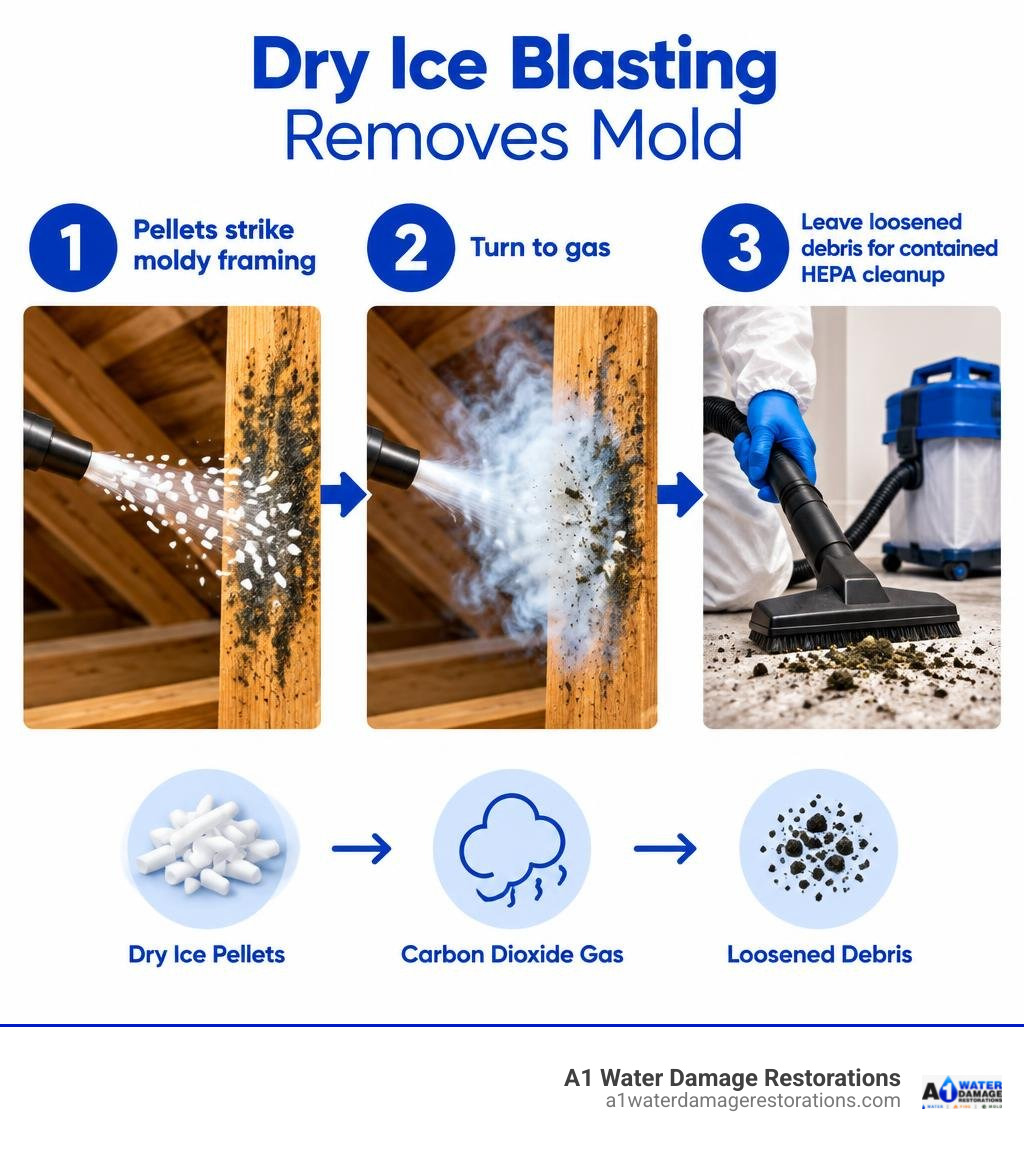
Dry ice blasting for mold remediation removes mold from exposed surfaces by firing solid carbon dioxide pellets at them. The impact loosens the growth, and the pellets turn to gas without adding water or leaving blasting grit behind. It can be useful on hard-to-reach framing, but it is only one part of the job. Crews must contain and collect the loosened particles, clean the area, and fix the moisture problem that allowed mold to grow.
I’m Cole Nudel, and I work in disaster restoration with A1 Water Damage Restorations in the Denver area. That experience shapes this guide to dry ice blasting mold remediation: when it may help, and why careful cleanup matters just as much as the blast.
Related content about dry ice blasting mold remediation:
The Science Behind Dry Ice Blasting Mold Remediation
To understand why cryogenic cleaning is so effective, we have to look at the physics of the blast. The process accelerates recycled, solid carbon dioxide (CO2) pellets using compressed air streams up to supersonic speeds. When these micro-pellets strike a contaminated substrate, three distinct mechanisms occur in rapid succession: kinetic impact, micro-thermal shock, and thermodynamic expansion.
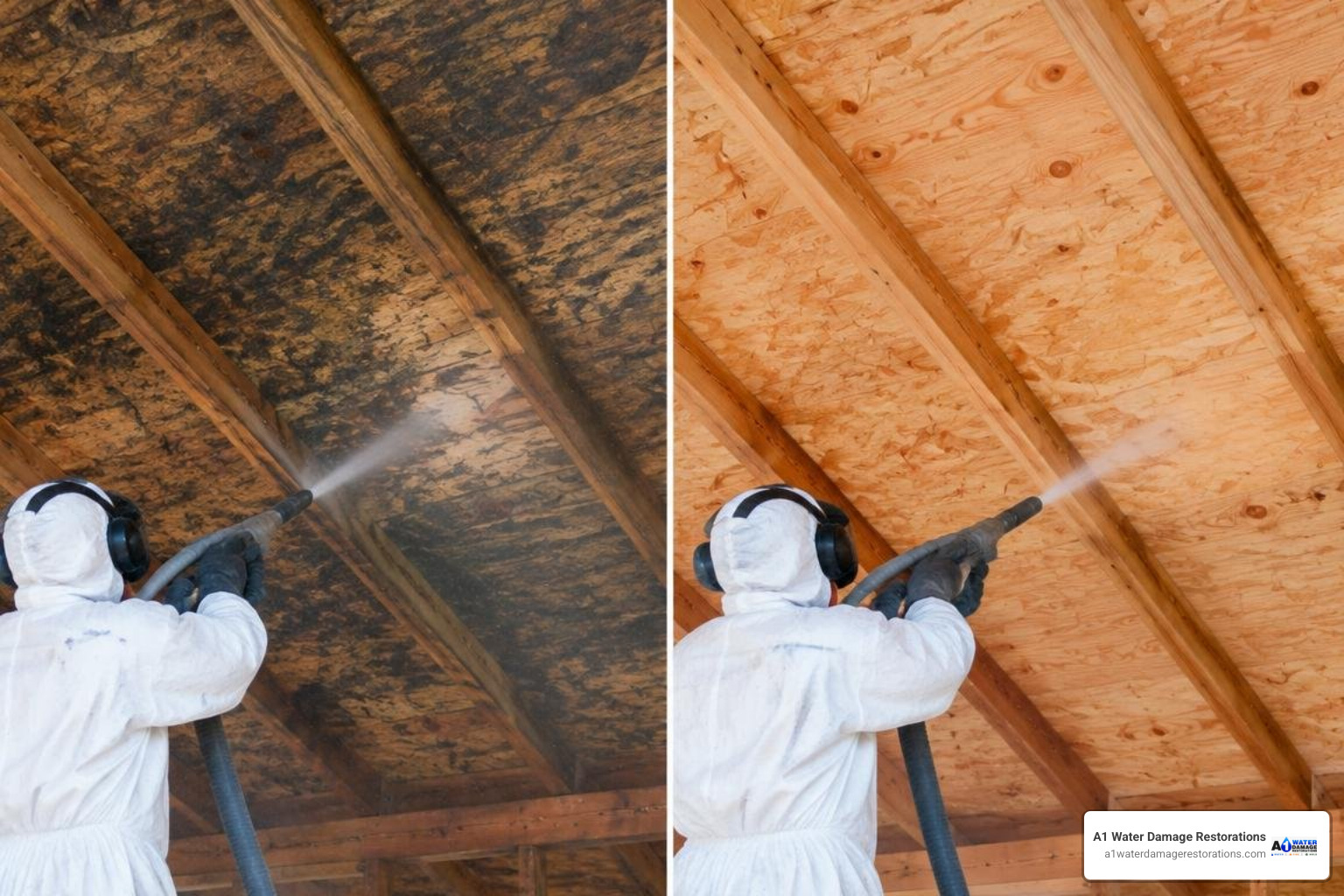
First, the kinetic energy of the pellets fractures the top layer of fungal growth. Because solid dry ice exists at approximately -109.3°F (-78.5°C), the extreme cold instantly causes the mold colonies and the contaminated wood fibers to contract rapidly. This flash freezing makes the mold brittle and breaks the bond between the fungal hyphae (the “roots”) and the wood substrate.
Second, the freeze-fracture mechanism reaches deep into the porous cellular structure of wood. Fungi do not simply sit on the surface; they root down into timber grain. Traditional scraping often snaps off surface fruiting bodies while leaving living root structures intact. Dry ice pellets shock and lift these embedded structures without tearing up the underlying structural timber. You can learn more about framing preservation in our guide on attic mold remediation and treatment.
Sublimation and Zero Secondary Waste
The real magic of solid CO2 is sublimation. In physics, sublimation is the transition of a substance directly from a solid state to a gas, bypassing the liquid stage entirely. When dry ice pellets hit a surface at room temperature, they warm instantly, expanding roughly 700 to 800 times in volume within milliseconds.
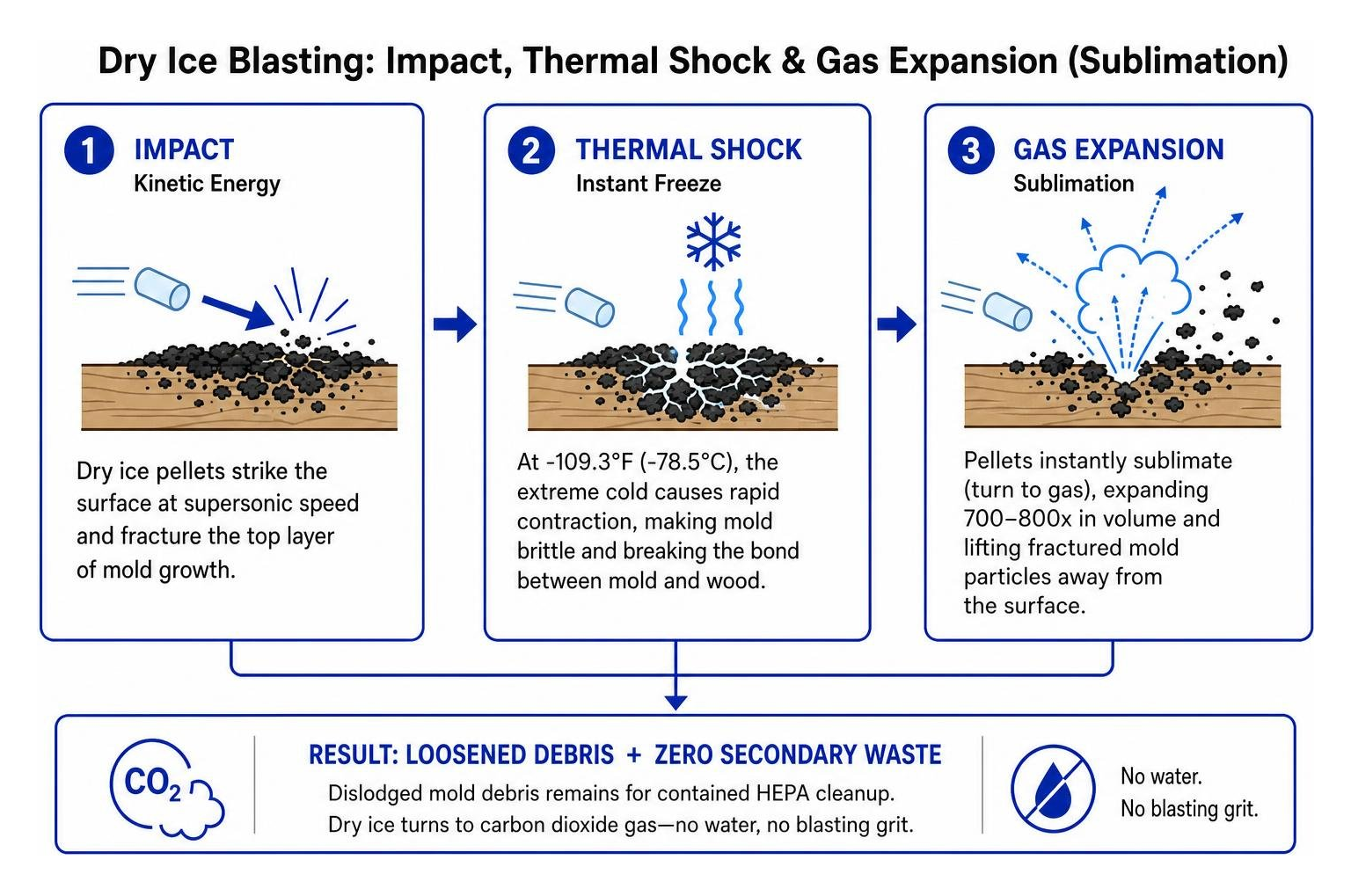
This explosive gas expansion literally lifts the fractured mold particles away from the surface from underneath. Because the media turns entirely into harmless carbon dioxide gas, no secondary grit waste is produced. Unlike sandblasting or walnut shell blasting, which leaves behind hundreds of pounds of contaminated blasting media mixed with mold spores, dry ice leaves behind only the dislodged fungal debris. Furthermore, because no liquid water is introduced, building materials remain bone-dry, eliminating any risk of adding moisture to the structure.
Efficacy and 99% Mold Spore Removal
When performed according to Indoor Air Quality Association (IAQA) and Institute of Inspection, Cleaning and Restoration Certification (IICRC) standards, dry ice blasting achieves a 99% mold spore removal rate on structural wood.
Traditional sanding and wire-brushing often leave microscopic spores embedded in irregular timber surfaces, knot holes, and around roofing nails. Dry ice pellets conform to irregular contours, effectively scouring crevices that hand tools cannot reach. This delivers a degree of surface decontamination that satisfies the strictest clearance criteria. For a broader overview of how media blasting integrates into total property recovery, review our comprehensive guide to mold remediation.
Dry Ice Blasting Considerations for Mold Remediation
When managing structural fungal contamination, restoration professionals must weigh several factors according to the IICRC S520 standard for professional mold remediation.
| Remediation Method | Secondary Waste Produced | Moisture Added to Structure | Substrate Wear & Tear | Relative Cleanup Time |
|---|---|---|---|---|
| Dry Ice Blasting | None (pellets sublimate into gas) | 0% (completely dry) | Very Low (non-abrasive) | Fast (minimal media disposal) |
| Sand / Media Blasting | Heavy (hundreds of lbs of grit) | 0% (dry) | High (abrades wood framing) | Slow (tedious grit collection) |
| Soda Blasting | Moderate (bicarbonate dust) | Low | Low to Moderate | Moderate (requires neutralizing) |
| Manual Hand Sanding | Low (sandpaper, dust) | 0% (dry) | Moderate | Very Slow (labor-intensive) |
| Chemical Washing | Moderate (chemical runoff, rags) | High (liquid solutions) | Chemical alterations | Moderate (requires drying time) |
Evaluating these variables is especially vital when developing effective post-flood mold removal strategies, where structural materials may already be compromised by excess moisture.
Why Physical Removal Matters
A common misconception in property maintenance is that applying biocides, bleach, or chemical encapsulants is enough to “kill” mold. However, industry science confirms that non-viable (dead) mold spores, fungal fragments, and mycotoxins remain toxic and allergenic even after chemical treatment. Inhaling dead spores can trigger identical respiratory and immune reactions as inhaling living spores.
True remediation requires source removal. By using dry ice blasting to physically detach fungal colonies, remediation professionals eliminate the mycotoxin reservoir completely. We avoid masking the problem with heavy coatings or biocides that off-gas volatile organic compounds (VOCs), ensuring the indoor environment is safe for chemically sensitive occupants.
Project Timelines and Labor Cost Reduction
Manual remediation of an attic or crawlspace using wire brushes, scrapers, and orbital sanders is exhausting, slow work. In complex roof trusses, hand-sanding an entire sub-roof can take a four-person crew an entire week.
By contrast, dry ice blasting can cut project timelines dramatically, frequently saving three to four full days compared to manual abrasion or media blasting. Because the dry ice sublimates instantly, crews do not lose time sweeping, collecting, and disposing of tons of heavy abrasive media like sand or corn cob grit. This efficiency significantly reduces total labor hours, helping property owners manage overall mold remediation costs and budgeting without cutting corners on cleanliness.
Safety Protocols, Containment, and Medical Consensus
Because dry ice blasting creates high kinetic energy and generates substantial volumes of carbon dioxide gas, strict engineering controls are non-negotiable.
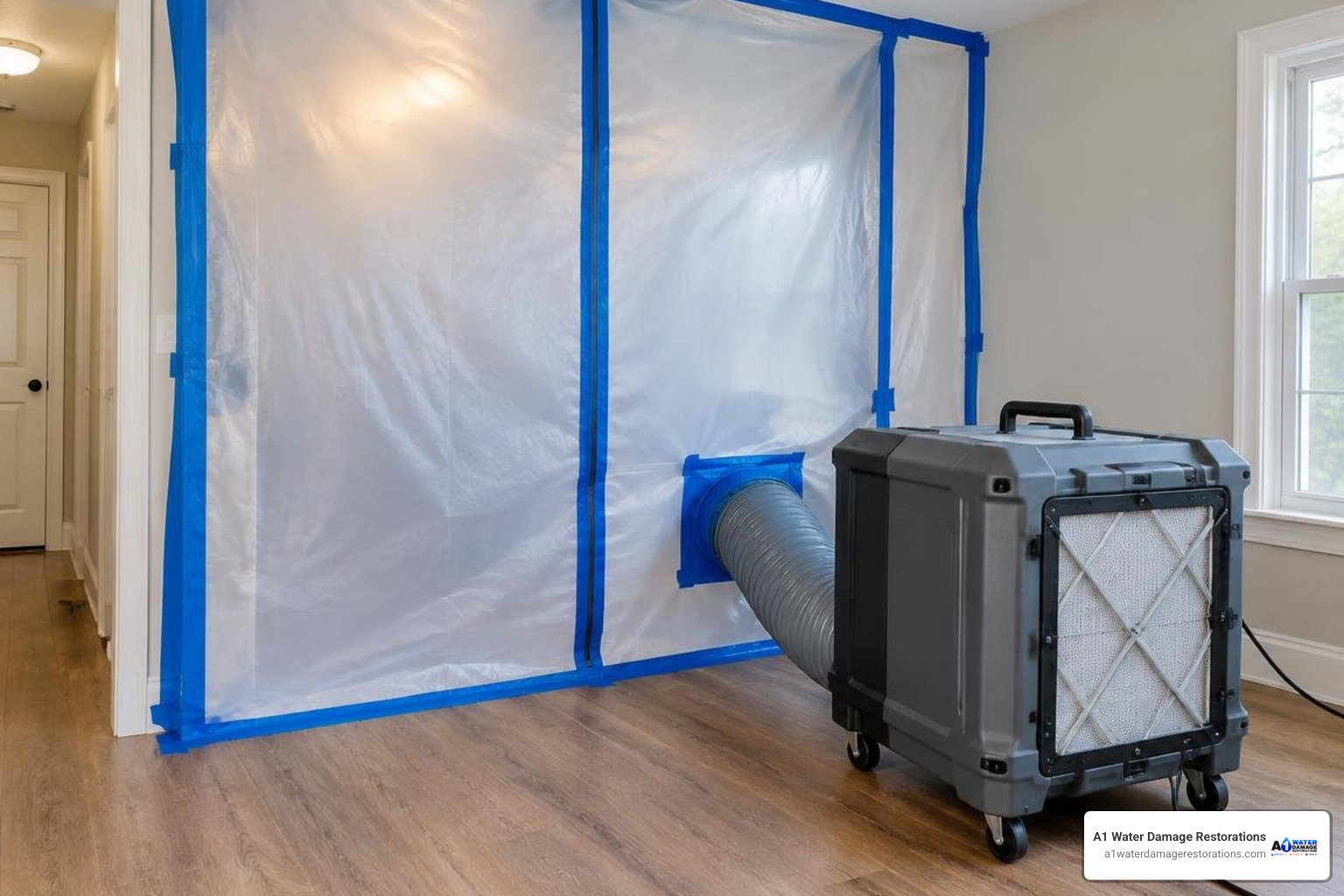
Remediation teams must erect tight containment barriers using fire-retardant 6-mil polyethylene sheeting. We establish continuous negative air pressure differentials—typically between 5.0 and 7.0 Pascals—using specialized commercial air movers equipped with HEPA (High-Efficiency Particulate Air) filtration. These units exhaust displaced air safely to the building exterior, capturing 99.97% of particulates down to 0.3 microns and preventing disturbed spores from escaping into unaffected living spaces.
For more technical background on clinical indoor air standards, the Surviving Mold IEP Consensus Statement provides exhaustive protocols for handling environmentally induced illnesses.
Medical-Grade Standards and Dry Ice Blasting for Mold Remediation
For individuals suffering from Chronic Inflammatory Response Syndrome (CIRS) or extreme mold sensitivities, medical-grade remediation protocols must be followed. The consensus among environmental professionals is that media blasting must be paired with extensive source-containment controls.
In these critical projects, porous materials such as carpets, pads, and exposed insulation within the containment zone must be removed rather than surface-cleaned, as micro-particles settle deeply into textile fibers. Post-remediation verification (PRV) testing—including laser particle counts and fungal spore trap sampling—ensures that the indoor microbiome is returned to a clean, normal condition (Condition 1 status as defined by the IICRC).
Critical Safety Gear and CO2 Risk Mitigation
The sublimation of solid dry ice releases large volumes of gaseous CO2, which is heavier than air and displaces oxygen, particularly in confined spaces like crawlspaces, basements, and unventilated attics.
Technicians must implement strict safety protocols:
- Respiratory Protection: Powered Air-Purifying Respirators (PAPR) or supplied-air respirators are required in tight, poorly ventilated workspaces to ensure breathable air.
- Gas Monitoring: Multi-gas monitors with real-time carbon dioxide and oxygen sensors must run continuously inside the containment zone.
- Thermal and Acoustic Protection: Insulated cryogenic gloves protect against frostbite when handling blast lines, and dual-layer hearing protection shields operators from high blast-nozzle decibels.
Key Remediation Scenarios and Structural Applications
Dry ice blasting is versatile, making it the preferred method for complex structural restoration across our service areas throughout Denver, Boulder, Littleton, Broomfield, and Arvada.

Structural wood, crawlspace joists, subflooring, and masonry foundations benefit substantially from cryogenic cleaning. Beyond fungal removal, dry ice blasting is exceptional for fire and smoke restoration. It removes 100% of charred wood and baked-in carbon, which traps persistent smoke odors. By removing the carbon layer down to clean, bare wood, the need for chemical odor sealers and masking agents is substantially minimized. You can see how these techniques align with mastering proper mold remediation protocols on complex residential properties.
Best Practices for Dry Ice Blasting Mold Remediation in Challenging Spaces
Attics and crawlspaces present difficult obstacles: dense nail plates, wiring harnesses, junction boxes, and delicate copper or PEX plumbing lines.
Because dry ice is non-conductive and non-abrasive compared to grit, certified operators can calibrate pellet density and nozzle pressure to scour tight angles and raw joist corners without cutting electrical wire sheathing or puncturing pipes. Adjusting blast pressure allows technicians to safely clean fragile historic wood sheathing in older Denver homes without stripping away the substrate’s structural integrity.
Post-Blast HEPA Vacuuming and Quality Verification
Blasting dislodges mold from wood, but those aerosolized spores and fine wood dust particles must be physically extracted from the air and surfaces.
Once the blasting sequence is complete:
- Settling Time: Negative air machines run continuously to cycle the air volume multiple times per hour.
- HEPA Vacuuming: Technicians conduct a thorough HEPA vacuuming pass over all horizontal and vertical surfaces, framing, plates, and containment plastic.
- Damp Wiping: Surfaces are wiped using microfiber cloths and clean surfactant solutions.
- Environmental Clearance: An independent Indoor Environmental Professional (IEP) conducts visual inspections and air/surface sampling to certify the containment zone has passed clearance.
Frequently Asked Questions about Dry Ice Blasting for Mold
Does dry ice blasting add moisture to wooden framing?
No. Dry ice is solid carbon dioxide, not frozen water. When it impacts the wood, it sublimates directly into CO2 gas, leaving zero liquid moisture behind. This ensures framing remains completely dry, which is essential because excess moisture is what allows mold colonies to incubate initially.
How does dry ice blasting ensure mold spores do not spread to other rooms?
Cross-contamination is prevented by establishing complete containment zones using 6-mil poly barriers, sealed doorways, and continuous negative air pressure machines fitted with HEPA filters. Air is continually exhausted outdoors, drawing fresh air into the work area and preventing airborne fungal spores from migrating into unaffected living quarters.
Can dry ice blasting remove mold odors and smoke char simultaneously?
Yes. Cryogenic blasting physically strips away 100% of the contaminated carbon layer and surface mold where odor-causing volatile organic compounds are trapped. By removing the contaminated layer down to clean, bare timber, odors are eliminated at the source without relying heavily on chemical masking sprays or sealants.
Conclusion
Dry ice blasting provides a rapid, environmentally friendly, and highly effective approach to removing persistent fungal contamination from structural framing. By physically dislodging mold roots, eliminating secondary grit waste, and keeping building materials completely dry, cryogenic cleaning delivers lasting results that protect the health of your home and family.
At A1 Water Damage Restorations, our IICRC-certified technicians bring extensive experience, specialized equipment, and rapid response times to every project across the Denver Metro Area, Boulder, Golden, Greenwood Village, and Westminster. If you suspect fungal growth or water intrusion in your property, explore our professional mold removal services or reach out to our team today to restore your property safely and thoroughly.