

Common Causes of Property Damage in the Mile High City
Denver damage restoration involves emergency water extraction, high-altitude structural drying, fire and smoke remediation, mold removal, and full code-compliant reconstruction. Professional restoration teams stabilize compromised residential and commercial properties immediately after disaster strikes, halting secondary water migration and structural deterioration.
Denver sits at 5,280 feet, nestled against the Front Range. While our panoramic mountain views and 300 days of sunshine make it an exceptional place to live, our unique geography also creates specific property hazards. Rapid temperature swings, seasonal storm fronts, and shifting soil present continuous challenges for residential and commercial structures alike. Approximately 40% of Denver homeowners file at least one property damage claim related to severe weather events such as hail, wind, or snow every five years.
Understanding how local environmental factors impact your home helps you spot vulnerabilities early and take preventive action before minor issues escalate into catastrophic losses.
Denver Damage Restoration for Weather and Hail Events
Colorado is positioned directly within “Hail Alley,” a multi-state corridor experiencing the highest frequency of severe hail in North America. Denver averages between 80 and 100 hail days every year, consistently ranking among the top U.S. cities for property damage claims caused by hail. When golf-ball-sized hail strikes a neighborhood, it tears through roofing shingles, dents flashing, punctures siding, and shatters skylights.
These impacts create entry points for sudden rainwater intrusion. High Front Range wind gusts push heavy rain beneath damaged roofing materials, allowing moisture to seep into attics, saturate ceiling insulation, and travel down internal wall cavities. When severe storms strike, our certified Denver storm damage restoration crew deploys emergency tarping and structural stabilization immediately to halt further interior water migration.
Freeze-Thaw Cycles, Snowmelt, and Basement Flooding
Winter in Denver brings sub-zero Arctic blasts followed quickly by warm, sunny days driven by Chinook winds. These extreme freeze-thaw cycles place severe stress on building foundations and plumbing systems. In 2023, Colorado recorded over 15,000 residential water damage claims, with the Denver metro area accounting for approximately 30% of those incidents.
Freeze-thaw cycles cause roughly 12% of all basement flooding and foundation damage claims across Denver each year. During winter drops, uninsulated pipes along exterior walls freeze and burst. When spring arrives, rapid snowmelt saturates the soil around foundations. Denver’s expansive clay soils expand when wet, creating hydrostatic pressure against foundation walls. This force drives water through hairline masonry cracks, flooding finished basements and utility rooms. For severe incidents involving combined runoff and sewer line backpressure, our specialists follow the ultimate Denver sewage flood mitigation guide protocols to safely sanitize and decontaminate living spaces.
Core Types of Denver Damage Restoration Services
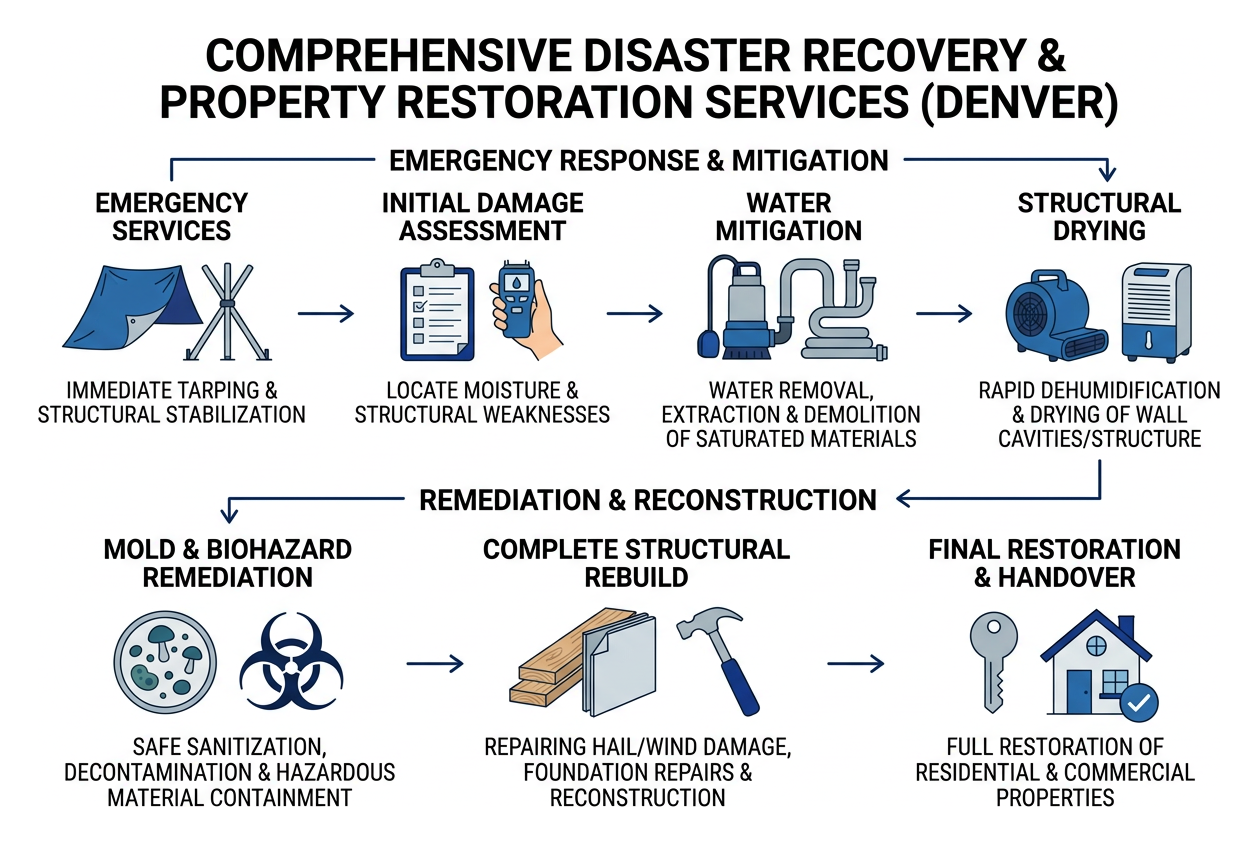
Property damage rarely stays confined to one isolated area. Water travels along joists, soot circulates through ventilation ducts, and mold spores spread wherever moisture lingers. Professional restoration requires a comprehensive approach covering emergency mitigation, hazardous material containment, and complete structural rebuilds across residential and commercial properties.
Water Damage Mitigation and Structural Drying
Water damage falls into three main categories based on the source and level of biological contamination:
- Category 1 (Clean Water): Originates from broken supply lines, overflowing sinks, or rainwater leaks. It poses minimal immediate risk but degrades into Category 2 within 24 to 48 hours if left unaddressed.
- Category 2 (Gray Water): Contains chemical or organic contaminants from appliance discharges, sump pump failures, or washing machine overflows that can cause illness if contacted.
- Category 3 (Black Water): Highly unsanitary water from sewage backups, river flooding, or standing water that has supported microbial growth. It contains dangerous pathogens and requires specialized disposal and antimicrobial remediation.
Professional mitigation begins with heavy-duty submersible pumps and truck-mounted extraction units to remove bulk water. Technicians then deploy targeted cavity-drying equipment, floor-mat drying systems, and commercial dehumidifiers. Our Denver water damage restoration experts monitor the drying process daily using calibrated thermo-hygrometers and penetrating moisture meters, ensuring all framing and subflooring reach safe equilibrium moisture content. The average cost of professional water damage restoration in Denver ranges from $1,500 to $7,000, depending on the square footage affected and the water category involved.
Fire, Smoke, and Soot Remediation
Structural fires leave behind layered damage: charred framing, acidic soot coatings, pervasive smoke odor, and extensive water accumulation from firefighting efforts. Fire damage restoration in Denver typically ranges from $3,000 to $25,000, and our teams maintain an average response time of 2 to 4 hours to prevent permanent acidic etching on surfaces.
Acidic soot bonds quickly to glass, metal, tile, and stone surfaces, causing permanent pitting and discoloration within hours. Restoring fire-damaged properties requires:
- Soot Removal: Utilizing dry chemical sponges, HEPA vacuums, and specialized alkaline solutions to lift soot without driving it deeper into porous surfaces.
- Thermal Fogging and Ozone Treatments: Neutralizing smoke odor particles at the molecular level within hidden framing cavities and insulation.
- HVAC Air Duct Decontamination: Clearing contaminated ductwork to eliminate airborne particulates and restore clean indoor air.
For detailed property owner guidance during fire emergencies, explore our Denver fire damage solutions and consult the Fire Restoration Denver Buyers Guide for 2026 for comprehensive recovery planning.
Mold Remediation and Air Quality Control
Whenever moisture enters building materials and remains for more than 24 to 48 hours, microscopic mold spores germinate. In high-altitude indoor environments with central heating, fungal colonies multiply behind baseboards, under vinyl flooring, and inside insulated drywall cavities.
Untreated mold exposure introduces significant health risks, including allergic rhinitis, asthma flare-ups, chronic respiratory irritation, and fungal infections in immunocompromised individuals. Following established EPA guidelines on mold remediation, our Denver mold removal technicians operate under strict containment protocols:
- Physical Isolation: Erecting heavy-duty polyethylene barriers to seal off contaminated areas from unaffected rooms.
- Negative Air Pressure: Using industrial air scrubbers with HEPA filtration to maintain negative pressure, ensuring airborne spores cannot escape the containment zone.
- Antimicrobial Cleaning and Encapsulation: Removing non-salvageable porous items, scrubbing semi-porous framing with EPA-registered antimicrobials, and applying mold-resistant coatings.
The Step-by-Step Restoration and Reconstruction Process
Recovering from property damage requires a disciplined, multi-phase process designed to stabilize your structure, eliminate biological risks, and rebuild damaged spaces seamlessly.
Following a structured recovery roadmap ensures that no hidden moisture or structural vulnerabilities are overlooked:
- Initial Assessment and Safety Inspection: Technicians survey the site using FLIR thermal imaging cameras and non-invasive moisture meters to map the full path of moisture migration or fire spread.
- Emergency Mitigation and Containment: Crews secure the exterior with boards and tarps, isolate utility lines, and establish containment barriers.
- Water Extraction and Controlled Demolition: Standing water is pumped out, and non-restorable materials (such as saturated drywall, ruined padding, or charred trim) are carefully removed.
- Therapeutic Drying and Deodorization: Industrial air movers and desiccant dehumidifiers run continuously while technicians take daily psychrometric readings.
- Sanitization and Antimicrobial Application: All surfaces receive medical-grade antimicrobial washdowns to eliminate bacteria, mold, and odor.
- Structural Reconstruction: Licensed carpenters and contractors hang new drywall, install flooring, repaint, and rebuild structural elements.
Homeowners can review our detailed step-by-step guide to water damage restoration for an in-depth look at each mitigation phase.
Advanced Drying Techniques at High Altitude
Drying a structure in Denver differs significantly from drying a home at sea level. Denver’s low atmospheric pressure and dry outdoor air create unique psychrometric dynamics. While the ambient air is naturally dry, our high altitude causes surface moisture on drywall and flooring to evaporate rapidly into the room air.
If this evaporated moisture is not captured immediately by properly calibrated dehumidification systems, it creates a “secondary damage” cycle. High vapor pressure differentials cause moisture to travel deep into porous structural framing, subfloors, and concrete foundations. We use balanced psychrometric drying setups, combining Low Grain Refrigerant (LGR) and desiccant dehumidifiers to maintain a consistent vapor pressure deficit that draws deep, trapped moisture out of dense construction materials.
Denver Damage Restoration Permits and Reconstruction
Restoration does not end when the moisture readings reach dry standard baselines. Structural reconstruction must comply with the City and County of Denver Building and Fire Code as well as municipal codes across surrounding communities like Littleton, Golden, Arvada, and Westminster.
Permits are typically required when reconstruction involves:
- Removing or replacing load-bearing wall studs
- Rerouting electrical circuits damaged by water or fire
- Replacing major plumbing lines or sewer laterals
- Rebuilding framing or structural roofing assemblies
Our dedicated Denver reconstruction services team manages the entire process from structural engineering and permit acquisition through final municipal inspections, ensuring your property is fully restored and completely code-compliant.
Colorado Insurance Claims and Choosing Certified Experts
Managing an insurance claim after a disaster can feel overwhelming. Knowing your policy terms, documenting losses thoroughly, and choosing an IICRC-certified restoration partner ensures a smooth, stress-free claims process.

Navigating Insurance Policies and Claim Documentation
Most standard Colorado homeowners insurance policies cover property damage that is “sudden and accidental,” such as a burst frozen pipe, lightning strike, or roof damage from a severe hailstorm. However, standard policies generally exclude:
- Gradual Leaks: Water seepage occurring over weeks or months due to neglected maintenance.
- Ground Flooding: Overland water runoff from heavy rains or creek overflow (requires a separate NFIP flood insurance policy).
- Sewer Backups: Surcharges from municipal sewer mains into private basements (requires an optional sewer and drain backup rider).
To protect your claim, document the damage immediately. Take high-resolution photos and video of all damaged structural areas and personal belongings before cleanup starts. Keep an itemized inventory list of ruined items, including brand names, estimated age, and replacement values. A1 Water Damage Restorations uses industry-standard Xactimate estimating software, providing direct insurance billing with comprehensive moisture logs, thermal images, and itemized scopes of work that align with adjuster requirements.
What to Look for in a Licensed Restoration Specialist
Selecting a restoration contractor requires careful verification of credentials, emergency capabilities, and technical certifications. Not all contractors possess the specialized equipment and training required for structural drying and hazardous remediation.
| Evaluation Metric | Certified Professional Restoration Firm | Standard General Contractor |
|---|---|---|
| IICRC Certification | Certified in WRT, ASD, AMRT, and FSRT standards | Rarely holds specialized drying certifications |
| Emergency Response Time | 24/7/365 emergency dispatch within 60–120 minutes | Standard business hours only |
| Diagnostic Equipment | Thermal imaging, pinless moisture meters, psychrometric loggers | Basic moisture meters or visual inspection only |
| Insurance Integration | Xactimate pricing, direct billing, detailed moisture logs | Standard manual estimates, limited insurance coordination |
| Containment Capabilities | Negative air machines, HEPA scrubbers, OSHA biohazard safety | Basic dust plastic sheeting without negative pressure |
Always choose a team with verified IICRC (Institute of Inspection, Cleaning and Restoration Certification) credentials to ensure all drying and remediation work adheres strictly to S500 (Water), S520 (Mold), and S540 (Fire) industry standards.
Frequently Asked Questions About Denver Property Restoration
How quickly should restoration begin after property damage occurs?
Mitigation should begin within 24 to 48 hours of water intrusion. Microscopic mold spores naturally present in indoor environments begin germinating on damp organic surfaces, such as drywall paper and wood studs, within 24 hours. Delaying mitigation also allows standing water to soak into subfloors, warp hardwood, and weaken structural integrity. Immediate emergency response halts water progression and saves thousands of dollars in structural repairs.
Does homeowners insurance in Colorado cover damage restoration?
Homeowners insurance in Colorado typically covers sudden, unexpected events such as frozen pipe ruptures, sudden appliance leaks, roof hail damage, and structural fires. It generally does not cover damage resulting from deferred maintenance or slow, ongoing leaks. Overland flooding and sewer backups require specific policy endorsements, such as NFIP flood insurance or a water backup rider. Check your specific policy declarations and file claims promptly following an incident.
How does Denver’s altitude and dry climate affect structural drying?
Denver’s high altitude (5,280 feet) and low relative humidity accelerate the rate of surface water evaporation. While this may seem helpful, rapid surface evaporation without proper dehumidification creates high vapor pressure imbalances. Moisture can become trapped inside subfloors, wall cavities, and concrete foundations while the surface appears dry. Professional restorers at high altitudes use balanced drying systems with high-capacity dehumidification to pull trapped moisture out of structural components without causing warping or secondary microbial growth.
Conclusion
Property damage from severe hail, winter pipe bursts, sudden flash floods, or localized fires requires fast, informed action. Leaving moisture or soot unaddressed risks long-term structural weakness, widespread mold colonization, and compromised indoor air quality.
At A1 Water Damage Restorations, we provide 24/7 IICRC-certified disaster recovery across the Denver Metro Area, including Cherry Creek, Greenwood Village, Arvada, Westminster, Wheat Ridge, Broomfield, Littleton, Golden, and Boulder. As a family-owned restoration partner, we bring comprehensive in-house mitigation and reconstruction services paired with direct insurance claim assistance. If your property has suffered unexpected damage, don’t wait for secondary issues to develop. Contact our emergency team now to schedule your immediate Denver damage restoration service and restore your property safely and completely.