

Mold in Your Denver Business? Here’s What You Need to Know First
Commercial mold remediation in Denver is the professional process of identifying, containing, removing, and preventing mold growth in business properties — and for Denver property owners, acting fast is everything.
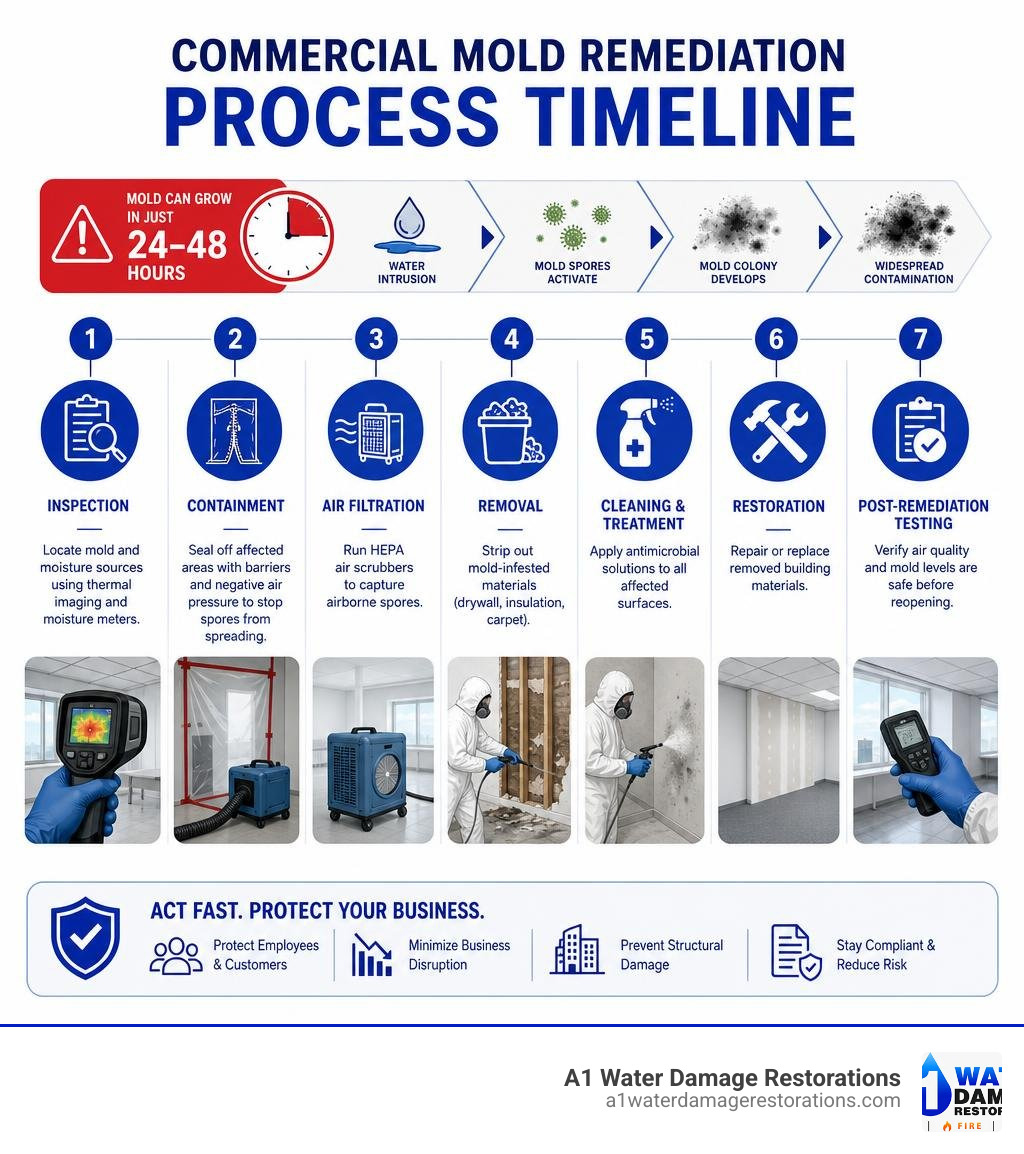
Quick answer: What does commercial mold remediation involve?
- Inspection — Locate mold and moisture sources using thermal imaging and moisture meters
- Containment — Seal off affected areas with barriers and negative air pressure to stop spores from spreading
- Air filtration — Run HEPA air scrubbers to capture airborne spores
- Removal — Strip out mold-infested materials (drywall, insulation, carpet)
- Cleaning and treatment — Apply antimicrobial solutions to all affected surfaces
- Restoration — Repair or replace removed building materials
- Post-remediation testing — Verify air quality and mold levels are safe before reopening
Mold doesn’t wait. It can begin growing within 24 to 48 hours after water intrusion — and in a busy Denver commercial building, that window closes fast. A small roof leak, a burst pipe, or an HVAC condensation problem can quietly turn into a serious contamination issue affecting your employees, your customers, and your bottom line.
The EPA recommends calling in professionals whenever mold covers more than 10 square feet in a commercial building. In large commercial spaces, that threshold is often crossed before anyone even notices the problem.
The stakes are higher in commercial settings than in homes. Larger spaces, complex HVAC systems, strict regulatory requirements, and the cost of business downtime all make commercial mold a different challenge entirely.
I’m Cole Nudel, a disaster restoration professional with A1 Water Damage Restorations in the Denver area, where I work daily with property owners navigating the complexities of commercial mold remediation in Denver and the surrounding metro. In this guide, I’ll walk you through everything you need to know — from causes and health risks to the step-by-step remediation process and how to choose the right team.
Must-know commercial mold remediation Denver terms:
Why Commercial Mold Remediation Denver is Critical for Businesses
When mold invades a commercial space, it is not just an aesthetic issue or a minor nuisance. It represents a direct threat to your property value, your operational continuity, and your indoor air quality. Commercial buildings in the Denver Metro Area—whether an office in Cherry Creek, a retail shop in Westminster, or a warehouse in Arvada—house expensive inventory, sensitive electronics, and structural materials that mold can easily destroy.
Left untreated, mold eats away at organic materials like wood, drywall, ceiling tiles, and carpet. Over time, this compromises the structural integrity of your building, leading to incredibly expensive reconstruction costs. More importantly, every hour your business is closed or operating at reduced capacity due to mold contamination translates directly to lost revenue. Implementing timely Why Implement Mold Removal Strategies for Commercial Properties is the single best way to protect your physical and financial assets.
Key Differences: Commercial vs. Residential Mold Services
Many business owners assume that mold remediation is the same regardless of whether it occurs in a house or a commercial facility. In reality, commercial projects are vastly more complex.
| Feature | Residential Mold Remediation | Commercial Mold Remediation |
|---|---|---|
| Scale & Scope | Typically confined to small, localized areas (e.g., a basement or bathroom). | Involves large square footage, multi-story layouts, and shared air systems. |
| Equipment | Standard commercial-grade dehumidifiers and air scrubbers. | Large-scale industrial desiccant dehumidifiers and complex negative air setups. |
| HVAC Complexity | Simple, localized ductwork. | Massive, interconnected commercial HVAC systems that can rapidly spread spores. |
| Regulations | Primarily guided by state recommendations and local health guidelines. | Strict OSHA compliance, building codes, and extensive liability documentation. |
| Operational Impact | Families can temporarily relocate or avoid specific rooms. | Direct threat to business revenue, tenant safety, and employee productivity. |
Because of these differences, trying to tackle a commercial mold issue with residential techniques simply won’t work. It requires deploying 3 Key Strategies for Commercial Mold Removal that prioritize minimal business disruption and thorough containment.
Colorado Mold Regulations and OSHA Compliance
Operating a business in Colorado means adhering to strict safety and health standards. Under the Occupational Safety and Health Administration (OSHA) General Duty Clause, employers are legally required to provide a safe workplace free from recognized hazards—and this includes toxic mold. If employees are exposed to hazardous mold levels, businesses face severe liability risks, worker’s compensation claims, and potential regulatory fines.
Furthermore, local guidelines from agencies like Mold – Boulder County emphasize the importance of maintaining dry, well-ventilated indoor spaces. For properties in Broomfield, Golden, and Westminster, working with a certified professional ensures that your project complies with all local environmental regulations. To protect your business from legal liabilities, it is highly recommended to obtain professional testing and clearance documentation from a recognized Westminster mold testing resource.
Navigating Commercial Property Insurance Claims
One of the most stressful parts of discovering mold is wondering how you will pay for the cleanup. Most commercial property insurance policies will cover mold remediation only if the mold is a direct result of a covered peril, such as a sudden water pipe burst or storm damage. They generally will not cover mold caused by long-term maintenance neglect or high indoor humidity.
Documenting the damage immediately is vital. When we arrive on-site, we map the moisture levels, take detailed photos, and compile the thorough reports your insurance adjuster needs. Understanding What to Know About Storm Damage Repair for Commercial Properties can help you prepare for the claims process and ensure that your mitigation costs are covered.
Common Causes and Health Risks of Mold in Denver Workspaces

Understanding what causes mold to grow in the first place is the key to preventing its return. In Colorado’s semi-arid climate, indoor mold is almost always tied to a localized water problem.
Primary Triggers for Commercial Mold Growth
Mold requires three things to thrive: moisture, a food source (like drywall or wood), and warm temperatures. While we cannot easily remove food sources or change building temperatures, we can control moisture. The most common culprits behind commercial mold growth include:
- HVAC Condensation: Commercial air conditioning units produce significant condensation. If drain pans clog or ductwork is poorly insulated, moisture accumulates inside ceiling cavities.
- Roof Leaks: Denver’s heavy spring snows and summer hailstorms can damage commercial flat roofs, allowing water to slowly seep into ceiling tiles.
- Plumbing Failures: High-use commercial restrooms, commercial kitchens, and aging pipe infrastructure in older buildings are prone to hidden leaks.
- Poor Ventilation: Spaces with high humidity and poor airflow, such as commercial kitchens or gym locker rooms, create perfect breeding grounds.
When water damage occurs, utilizing Effective Mold Removal Strategies for Commercial Water Damage is essential to dry the property out before spores can colonize. If a storm was the root cause, you can learn more about restoring your building by reading Storm Damage Repair for Commercial Properties Made Simple.
Health and Safety Risks for Employees and Customers
Allowing mold to linger in your building is a major health hazard. Mold spores are microscopic and easily airborne, meaning occupants breathe them in throughout the workday. For sensitive individuals, employees, or customers with pre-existing conditions, mold exposure can cause:
- Nasal and sinus congestion
- Chronic coughing, wheezing, and respiratory infections
- Severe asthma attacks
- Skin and eye irritation
- Fatigue and chronic headaches
In severe cases, exposure to specific molds (like Stachybotrys chartarum, commonly known as black mold) can lead to more serious systemic health issues. Protecting your staff and visitors is your primary responsibility as a business owner. When water or moisture strikes, securing When Disaster Strikes Expert Commercial Flood Restoration for Your Business ensures that mold never gets the chance to threaten occupant health.
Professional Mitigation: The Step-by-Step Process

When you hire a professional restoration company, you are not just getting a cleaning crew. You are getting a team of highly trained technicians using specialized equipment to safely isolate and eliminate the contamination.
The Step-by-Step Commercial Mold Remediation Denver Process
At A1 Water Damage Restorations, we follow a strict, industry-standard protocol for every commercial project we handle:
- Inspection and Assessment: We use advanced moisture meters and thermal imaging cameras to map out the hidden water sources behind walls and ceilings.
- Containment: We construct heavy-duty plastic containment barriers and put the affected space under negative air pressure. This ensures that when we disturb the mold, no spores can escape into other areas of your building.
- Air Filtration: We deploy industrial HEPA air scrubbers that continuously clean the air, pulling out mold spores and microscopic dust.
- Material Removal: Porous materials that cannot be salvaged (such as wet drywall, saturated insulation, and ruined carpet) are carefully bagged and discarded.
- Surface Cleaning and Sanitizing: We physically scrub all non-porous and semi-porous surfaces using professional antimicrobial and antifungal treatments.
- Drying and Dehumidification: We use high-capacity dehumidifiers to ensure all remaining building materials are completely dry.
- Restoration and Rebuild: Once the area is cleared of mold, our in-house construction crew repairs and replaces the drywall, flooring, and paint to return your property to pre-loss condition.
If you are dealing with a suspected mold problem, finding the right certified professionals is critical. Read our guide on Professional Mold Remediation in Denver Finding the Right Experts to learn what to look for. For businesses in Greenwood Village, we recommend coordinating with a specialized Greenwood Village commercial mold testing provider to confirm clearance before reopening.
Advanced Equipment and Techniques Used by Professionals
Professional remediation relies heavily on specialized technology. We don’t just spray bleach and hope for the best (in fact, bleach is highly ineffective on porous surfaces like drywall!).
Instead, we use thermal imaging cameras to find moisture hidden deep within walls without tearing them down. We use moisture mapping to track the exact boundaries of water migration. Our HEPA-filtered negative air machines exchange the air in the containment zone multiple times per hour, trapping 99.97% of particles down to 0.3 microns. To understand how these tools fit into a broader water damage recovery plan, check out our Complete Guide to Commercial Water Damage Solutions.
Frequently Asked Questions about Commercial Mold
Here are some of the most common questions we receive from Denver-area commercial property managers and business owners.
How long does commercial mold remediation typically take?
The timeline for commercial mold remediation generally ranges from 3 to 7 days, though extremely large or complex projects can take longer. The exact duration depends on the size of the affected area, how deeply the mold has penetrated structural materials, and how much drying is required.
A standard dry-out takes about three days, but if moisture has seeped deep into concrete subfloors or complex wall cavities, the drying process must be extended to prevent the mold from immediately returning. Discovering what is included in these timelines can be found by exploring What Are Comprehensive Commercial Water Damage Services.
Can my business remain open during mold remediation?
In many cases, yes! Because we use strict containment protocols (sealing off the work area with physical plastic barriers and maintaining negative air pressure), we can isolate the mold completely. This allows your employees to continue working safely in other parts of the building.
For businesses that require absolute quiet or have high customer foot traffic, we can schedule our remediation work during nights, weekends, or off-hours to minimize the impact on your daily operations. We always coordinate closely with management to align our work with your business continuity plans, which is a key part of understanding What to Know About Storm Damage Repair for Commercial Properties.
How quickly should a business respond once mold is discovered?
You should respond immediately. Mold spores can begin colonizing within 24 to 48 hours of water exposure. Every day you delay allows the mold to spread further, increasing your remediation costs, extending your business downtime, and increasing health risks for your staff. Taking rapid action is the single most effective way to limit structural damage and save money. Learn more about the urgency of water cleanup by reading about Effective Mold Removal Strategies for Commercial Water Damage.
Conclusion
Dealing with mold in a commercial property can feel overwhelming, but you don’t have to navigate it alone. By understanding the causes, recognizing the health risks, and acting quickly to resolve moisture issues, you can protect both your building and the people inside it.
After remediation is complete, the best defense against future mold is a robust preventive maintenance plan. Regularly inspect your roof, service your HVAC systems, and keep indoor humidity levels below 50%. If you ever suspect a leak or discover mold growth, professional help is just a phone call away. For a complete list of how we can help keep your business safe, explore More info about our services.
Choosing the Right Partner for Commercial Mold Remediation Denver
When your business is on the line, you need a restoration partner you can trust implicitly. At A1 Water Damage Restorations, we are a family-owned business providing 24/7 IICRC-certified water, fire, and mold restoration across the entire Denver Metro Area—including Boulder, Cherry Creek, Golden, Greenwood Village, Arvada, Westminster, Wheatridge, Broomfield, and Littleton.
Our unique advantage is our ability to handle everything in-house, from the initial emergency water extraction and mold containment to the final structural rebuild. This seamless, single-point-of-contact approach minimizes delays, reduces administrative headaches with insurance companies, and gets your business back to normal faster than anyone else.
If you suspect mold in your commercial facility, don’t wait for it to spread. Contact the local experts at Denver Commercial Restoration today, and let us restore your property—and your peace of mind—better than ever.