

Understanding What Causes Mold in HVAC Ducts
To safely eliminate mold in HVAC ducts, you need professional containment, negative air pressure with HEPA filtration, EPA-registered antimicrobials on non-porous metal surfaces, and full replacement of porous duct board or flex duct that cannot be sanitized. Every time your air handler kicks on, it moves roughly 400 to 2,400 cubic feet of air per minute through your home. While this keeps your indoor climate comfortable, it also turns your ventilation network into a superhighway for microscopic particles. Mold spores are naturally present in outdoor and indoor air, but they require specific conditions to settle, colonize, and thrive inside your ductwork.
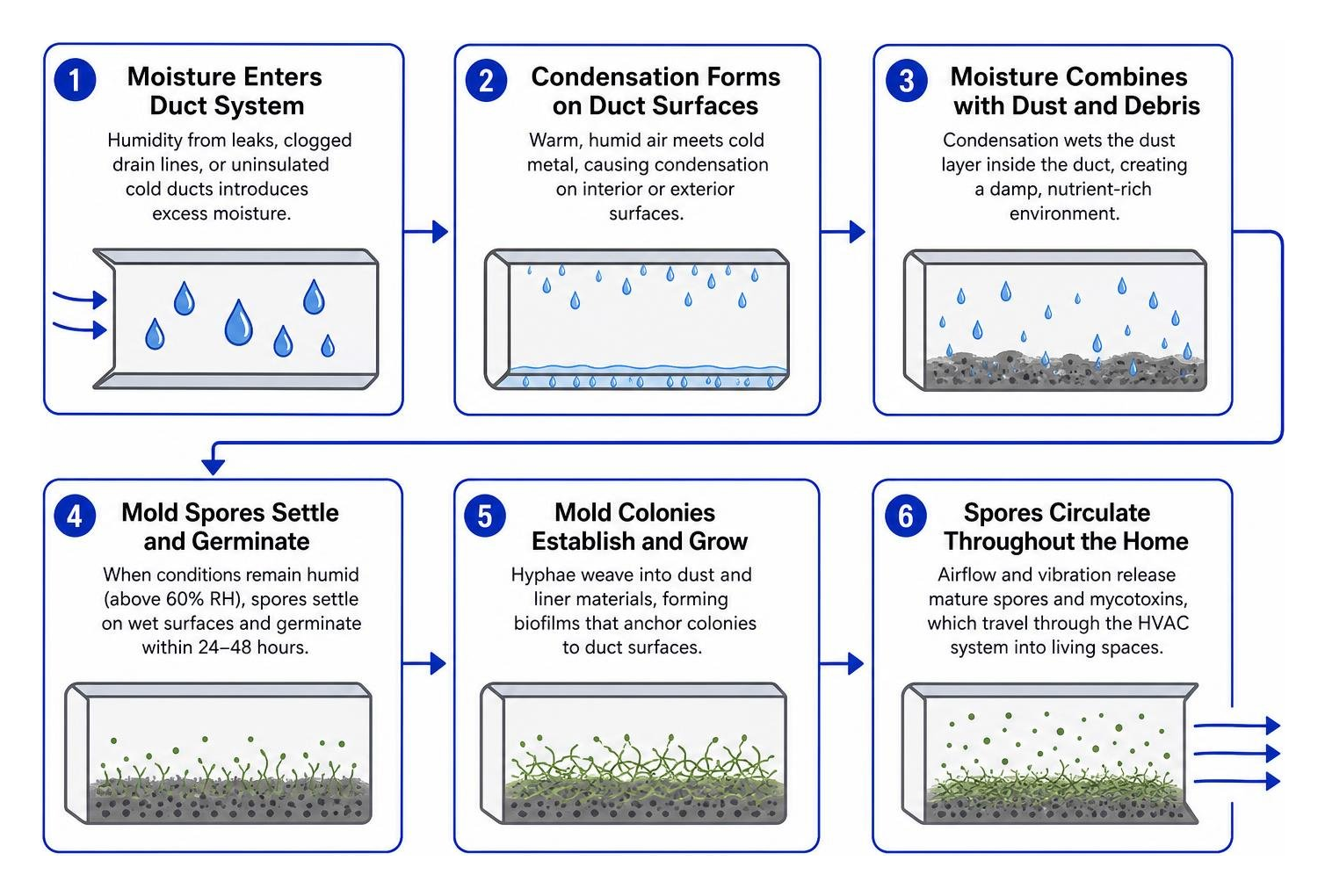
The primary catalyst for mold growth is unwanted moisture paired with organic debris. When warm, humid air collides with chilled metal or uninsulated duct runs, condensation quickly forms. If your ductwork has accumulated a layer of household dust—the average six-room home generates about 40 pounds of dust annually—those microscopic spores suddenly have both a steady water supply and an all-you-can-eat buffet.
System design flaws and installation oversights also play a massive role. An oversized air conditioning unit, for instance, cools a home too quickly without running long enough to pull moisture from the air. This short-cycling leaves high relative humidity lingering in your living spaces and inside the ducts themselves. Leaky duct joints can pull damp air from unconditioned crawl spaces, basements, or attics directly into the supply stream, accelerating condensation across the entire ventilation network.
Key Moisture Triggers and Condensation Points
Condensation rarely happens by accident; it is almost always the result of a mechanical failure or an unmanaged temperature differential:
- Clogged Condensate Drain Lines: The evaporator coil in your air handler draws gallons of water from the air daily. If the drain line backs up—a problem that affects roughly 45% of cooling systems over a five-year stretch—standing water fills the drain pan and creates an ultra-humid microclimate right next to your primary air supply.
- Dew Point Dynamics on Cold Metal: Uninsulated or poorly wrapped sheet metal ducts passing through unconditioned attics drop below the ambient dew point, causing the exterior and interior surfaces to “sweat” profusely.
- Cracked Plenums and Leaky Seams: The average residential system loses 20% to 30% of conditioned air through duct leaks. When negative pressure draws humid attic air into return ducts, moisture settles inside the distribution trunk.
How Mold Colonies Establish and Multiply
Mold does not wait around. Once relative humidity inside your ductwork exceeds 60% and moisture settles on surfaces, active mold colonies can establish within 24 to 48 hours. The spores germinate, sending out microscopic root structures called hyphae that weave into dust layers and porous duct liners.
As these colonies feed, they produce complex biofilms that anchor them securely against the airflow. When the HVAC blower turns on, the mechanical vibration and air rush detach mature spores and mycotoxins from the colony, circulating them straight into every connected room. Without addressing the underlying moisture problem, this cycle of amplification continues indefinitely.
Warning Signs You Have Mold in Air Ducts
Catching duct contamination early prevents minor colonization from turning into an expensive whole-home remediation project. Because the vast majority of your ductwork remains hidden behind drywall and subfloors, you need to rely on sensory indicators and system performance cues.
Identifying Visible and Olfactory Signs of Mold in HVAC Ducts
The most unmistakable warning sign is a persistent, damp, earthy odor—often described as smelling like wet cardboard or a neglected basement—that intensifies the moment the blower turns on. If the smell only appears while the air is circulating, the source is almost certainly located in the air handler, evaporator coil, or supply ducts.
Visually, you might spot dark speckling, greenish patches, or fuzzy white clusters collecting on the louvers of your supply registers. You may also notice dark ring stains on the drywall immediately surrounding your vents, signaling that cold air is causing localized condensation. If you spot localized grime on the exterior grilles, practicing safe and effective AC vent mold cleaning will help keep the surface clean, though persistent interior growth requires deeper professional evaluation.
Health and Respiratory Symptoms to Watch For
Contaminated ductwork directly impacts the air your family breathes. According to public health data, roughly 4.6 million asthma cases in the United States are attributable to dampness and mold exposure in buildings. When spores are actively blown through supply vents, building occupants may experience:
- Frequent morning sneezing fits, nasal congestion, and runny noses that improve when leaving the house.
- Unexplained coughing, throat tickles, and itchy, watery eyes.
- Sudden flare-ups in asthma symptoms or unexplained wheezing in otherwise healthy individuals.
- Chronic fatigue, headaches, or sinus pressure that tracks with seasonal HVAC use.
Vulnerable populations—including infants, the elderly, and anyone with compromised respiratory systems—are especially susceptible to mold-induced hypersensitivity pneumonitis and severe allergic reactions.
Step-by-Step Process for Safe HVAC Mold Remediation
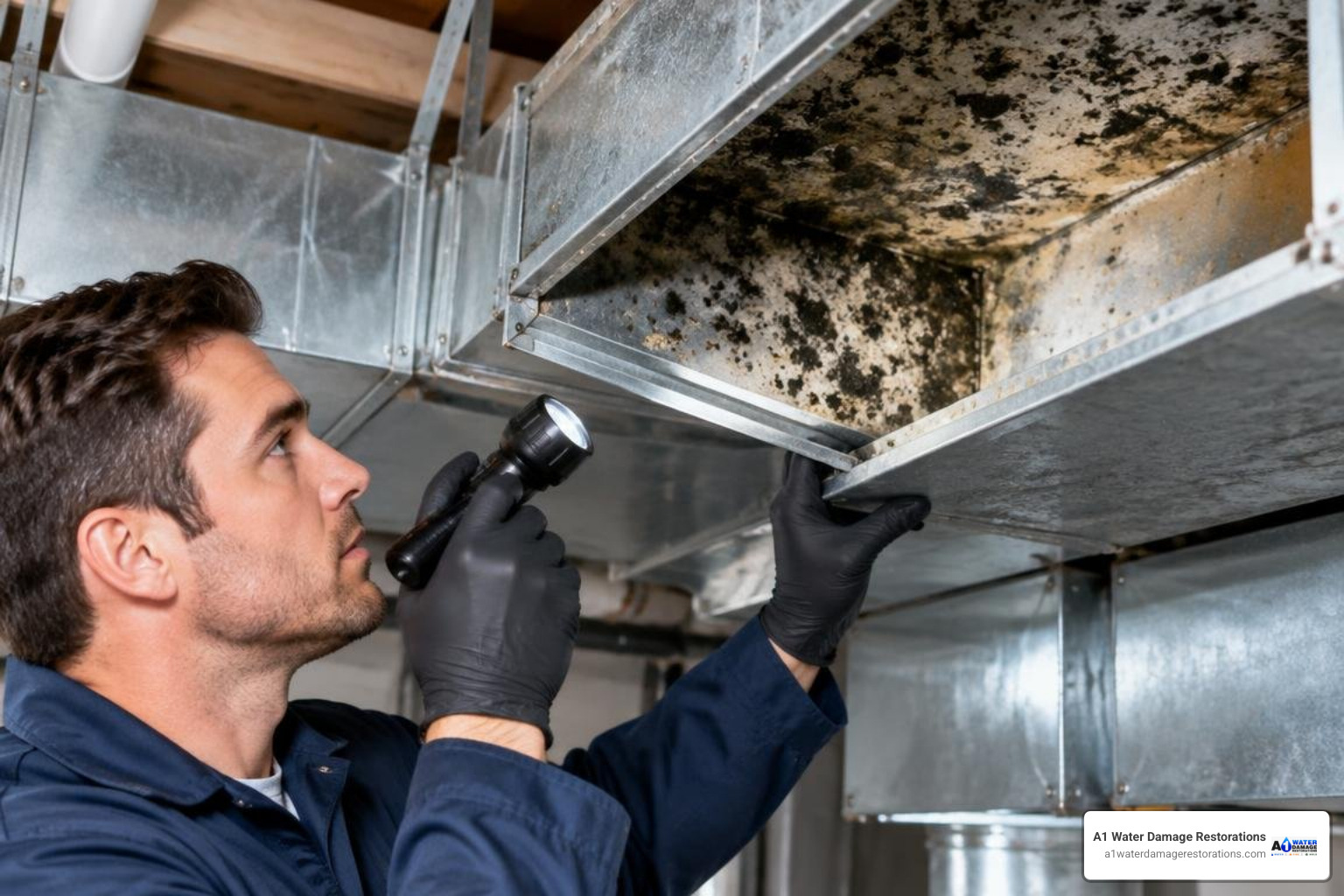
Remediating an HVAC system is fundamentally different from cleaning surface mold off a bathroom tile. Because ductwork acts as an air distribution loop, disturbing mold without engineered controls will rapidly contaminate your entire home. Following comprehensive mold remediation protocols ensures that spores are isolated and removed at the source.
Why DIY Bleach Cleaning Fails in Ductwork
A common homeowner reaction is to spray chlorine bleach or off-the-shelf disinfectants into the nearest vent. This approach often worsens the problem for several reasons:
- Bleach Cannot Penetrate Porous Substrates: Chlorine stays on the surface of porous materials like fiberglass duct board or internal insulation, while the water carrier soaks deeper, actually feeding the root structure of the mold.
- Aerosolized Spore Spread: Scrubbing dry mold colonies inside a duct without negative pressure sends millions of dormant spores airborne, distributing them across furniture, bedding, and carpets.
- Hazardous Fume Circulation: Introducing corrosive bleach fumes into a closed ventilation loop can damage internal HVAC components and create dangerous inhalation hazards for anyone inside the house.
For structural surfaces outside the ductwork, learning how to clean mold in your house safely requires the right tools and antimicrobials rather than harsh, ineffective household chemicals.
Professional Standards and the Proper Order of Work
Certified technicians follow strict protocols governed by the IICRC S520 Standard for Professional Mold Remediation and NADCA ACR standards. The process follows a systematic sequence:
- Diagnostic Borescope Inspection: Technicians insert flexible fiber-optic cameras into supply and return trunks to map the exact boundaries of microbial growth and inspect the evaporator coil.
- Full Containment Setup: The work area around the air handler is sealed with 6-mil polyethylene sheeting, and physical isolation barriers prevent spores from migrating into living areas.
- Negative Air Pressure & HEPA Scrubbing: High-powered negative air machines equipped with true HEPA filtration (capturing 99.97% of particles down to 0.3 microns) are attached to the duct trunk, creating continuous suction so that dislodged spores cannot escape into the home.
- Mechanical Agitation and Source Removal: Technicians use specialized rotary brushes, air whips, and HEPA vacuums to physically dislodge mold colonies, dust, and biofilms from non-porous surfaces.
- EPA-Registered Antimicrobial Treatment: Evaporator coils, drain pans, and bare sheet metal surfaces receive direct applications of EPA-registered, non-toxic antimicrobials formulated specifically for HVAC environments.
- Post-Remediation Clearance Testing: Before the containment comes down, third-party air sampling verifies that airborne spore counts inside the living spaces match or fall below normal outdoor background levels.
Working with certified mold duct cleaning services guarantees that these containment and extraction procedures are executed safely.
Duct Cleaning vs. Full Duct Replacement: Costs and Criteria
A central question during any HVAC remediation project is whether the existing ductwork can be safely cleaned or if it must be torn out and replaced. The answer hinges largely on the materials used in your system.
| Criteria | Professional Duct Remediation & Cleaning | Full Ductwork Replacement |
|---|---|---|
| Ideal Duct Material | Bare galvanized sheet metal, solid metal trunk lines | Flexible ductwork (mylar/wire), internally lined fiberglass board |
| Typical Cost Range | $500 – $1,200 (integrated with mold protocols: up to $2,200) | $3,500 – $8,000 (standard single-family home) |
| Average Project Timeline | 1 to 2 days | 2 to 5 days |
| Efficacy on Porous Liner | Low (cannot reliably sanitize embedded hyphae) | 100% (completely removes contaminated substrates) |
| Airflow Impact | Restores designed airflow by removing dust/blockages | Optimizes airflow with new, properly sized runs |
Deciding When Remediation Is Not Enough for Mold in HVAC Ducts
Non-porous materials, such as standard bare sheet metal ducts, can almost always be thoroughly remediated, sanitized, and returned to service. However, modern residential homes frequently use flexible ductwork—composed of a wire helix wrapped in plastic and encased in fiberglass insulation—or duct board constructed entirely from compressed fiberglass.
Once mold hyphae penetrate the porous fiberglass matrix or colonize the interior plastic liner of flex duct, surface cleaning is impossible under EPA and NADCA guidelines. Mechanical brushing shreds the fragile liner, releasing fiberglass particulates into your airstream while leaving deep mold roots intact. In these scenarios, complete removal and replacement of the affected runs is the only medically sound choice. If you are assessing the state of your ventilation, exploring duct mold remediation will help determine whether your materials can be salvaged.
Cost Breakdown for Mold Remediation and Replacement
The cost of addressing HVAC contamination varies based on system size, duct material, accessibility, and the extent of the growth. Nationally in 2026, homeowners pay an average of $2,254 for comprehensive mold remediation projects, with total costs generally spanning $1,125 to $3,439 depending on complexity.
- Standard NADCA-Compliant Cleaning with Antimicrobial Treatment: $500 to $1,200 for a typical 1,500–2,500 sq. ft. home with bare sheet metal ductwork.
- Targeted Coil & Air Handler Sanitization: Adds roughly $100 to $400 to standard duct cleaning services.
- Full System Duct Replacement: $3,500 to $8,000 for standard residential flex-duct or rigid configurations.
Homeowners insurance may cover remediation expenses if the mold resulted directly from a sudden, covered water peril (such as an abrupt pipe burst flooding an air return). However, if the mold developed due to long-term high humidity, deferred maintenance, or gradual drain pan leaks, policies typically exclude coverage.
Long-Term Strategies to Prevent HVAC Mold Recurrence
Remediating mold solves your current air quality crisis, but keeping it gone requires eliminating the environmental conditions that allowed it to grow in the first place.
Maintaining Proper Indoor Humidity Levels
The EPA advises keeping indoor relative humidity strictly below 60%, with an ideal operating window between 30% and 50%. When relative humidity crosses the 60% mark, condensation rapidly forms on cool duct surfaces, awakening dormant spores.
- Deploy Digital Hygrometers: Place small, inexpensive digital humidity monitors in living areas and basements to track moisture swings.
- Install Whole-Home Dehumidification: A properly functioning 3-ton AC system removes 15 to 20 pints of water per hour, but in humid weather or shoulder seasons, a dedicated whole-home dehumidifier ensures humidity never spikes.
- Flush Condensate Lines Quarterly: Pour a cup of distilled white vinegar down the condensate T-pipe every few months to prevent algae and slime from clogging the drain line.
- Mastic Seal All Duct Joints: Seal accessible duct seams with UL-181 listed mastic paste rather than standard duct tape, which degrades and leaks over time.
For property owners facing persistent moisture intrusion throughout their homes, partnering with a Denver mold remediation team helps identify structural water entry points before they impact the HVAC system.
Implementing UV-C Lights and Modern Filtration Upgrades
Upgrading your system’s filtration and sanitation technology creates an active defense against biological contaminants:
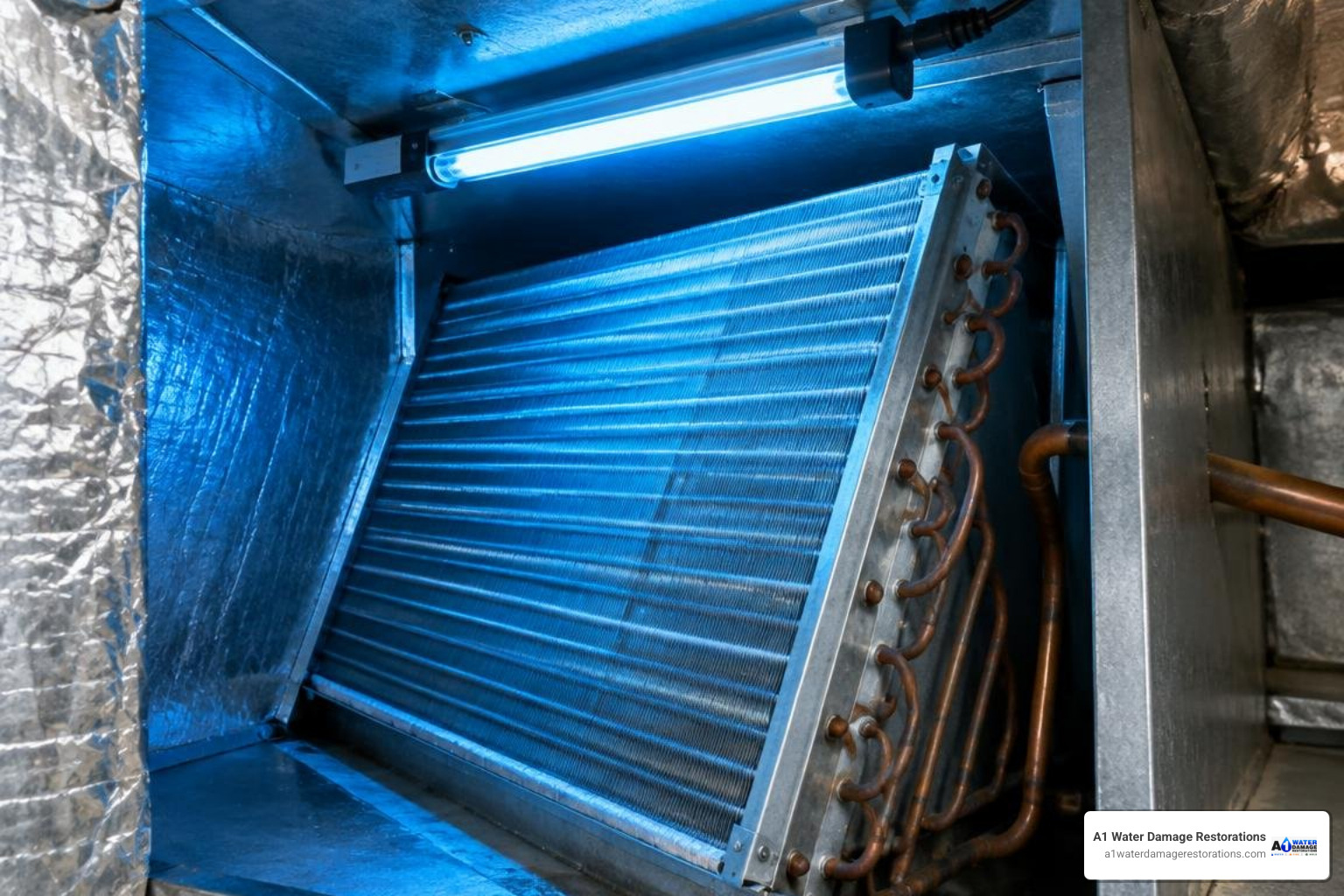
- UV-C Germicidal Lamps: Installing continuous UV-C lamps directly over the evaporator coil bathes the wet coil surface in germicidal light, reducing airborne mold spores and microbial biofilms by over 99% according to ASHRAE standards.
- High-Efficiency MERV Filtration: Upgrade from cheap fiberglass filters to pleated MERV 11 or MERV 13 filters. These capture microscopic spores and fine dust particles down to 0.3 microns, depriving mold of the nutrient bed it needs to settle.
- Bi-Annual System Servicing: Schedule spring and fall tune-ups to ensure coils are chemically washed, blower wheels are balanced, and refrigerant charges are dialed in to prevent coil freezing.
Frequently Asked Questions About HVAC Mold
Can running my AC spread duct mold throughout my entire house?
Yes. Because standard forced-air systems circulate hundreds of cubic feet of air per minute through a shared distribution trunk, running an HVAC system with active duct mold pushes microscopic spores into every connected room. If you discover visible growth or smell a strong musty odor when the system kicks on, shut the unit off at the thermostat immediately until an inspection can be performed.
How long does a professional duct mold remediation project take?
Most comprehensive HVAC remediation and sanitization projects take between 2 to 5 days. This timeframe accounts for setting up physical containment barriers, establishing negative air machines, mechanically brushing and vacuuming the duct runs, applying EPA-registered antimicrobials, allowing drying time, and conducting post-remediation air clearance testing.
Will standard homeowner insurance cover the cost of duct mold removal?
Coverage depends entirely on the root cause of the moisture. If the mold stems from a sudden, accidental water loss—such as a ruptured second-story supply pipe that flooded the furnace closet—remediation is often covered under standard policies. However, if the mold resulted from gradual condensation, unresolved humidity, or neglected maintenance, insurance providers will almost always deny the claim.
Conclusion
Discovering mold inside your ventilation network can feel overwhelming, but attempting quick DIY fixes with spray bottles and bleach will only compromise your indoor air quality further. By addressing the root moisture source, adhering to strict containment protocols, and replacing porous materials that cannot be safely sanitized, you can restore clean, healthy airflow to your home.
At A1 Water Damage Restorations, we understand the critical balance between effective microbial removal and protecting your home’s air envelope. Our IICRC-certified team provides 24/7 emergency response across Boulder, Cherry Creek, Denver, Golden, Greenwood Village, Arvada, Westminster, Wheatridge, Broomfield, and Littleton. We take pride in delivering comprehensive, in-house remediation with a personal touch—ensuring your HVAC system is thoroughly decontaminated and your indoor air is protected for the long haul.
If you suspect microbial growth in your ventilation system, don’t let it circulate through your living spaces. Explore our complete guide to expert HVAC mold cleaning and remediation to see how our proven containment and extraction methods can clear your air today.