
When Disaster Strikes Your Business: What Large Loss Restoration Really Means
Large loss restoration describes the specialized tier of property recovery triggered when damage exceeds $100,000 in scope — events like major commercial fires, building-wide flooding, or severe storm damage that affects multiple systems at once.
Here’s a quick snapshot of what defines a large loss and what recovery looks like:
| Standard Loss | Large Loss | |
|---|---|---|
| Typical cost | Under $100,000 | $100,000 to $5 million+ |
| Crew size | 1–3 technicians | Multi-trade teams |
| Timeline | Days to weeks | Months to over a year |
| Complexity | Single system | Multiple building systems |
| Insurance handling | Standard adjuster | Dedicated large-loss adjuster |
| Project oversight | Basic supervision | Dedicated project director |
If you own or manage a commercial property in the Denver Metro Area, a large loss event can halt operations overnight — with no warning. The financial hit from structural damage alone is severe. But business interruption, contents loss, and insurance complexity can multiply that impact fast.
The stakes are high, and the recovery process is anything but simple.
I’m Cole Nudel, a disaster restoration professional with A1 Water Damage Restorations serving the Denver area, where I’ve guided property owners through the full spectrum of large loss restoration — from the first emergency call to final rebuild. This guide will walk you through everything you need to know to navigate a major loss with clarity and confidence.
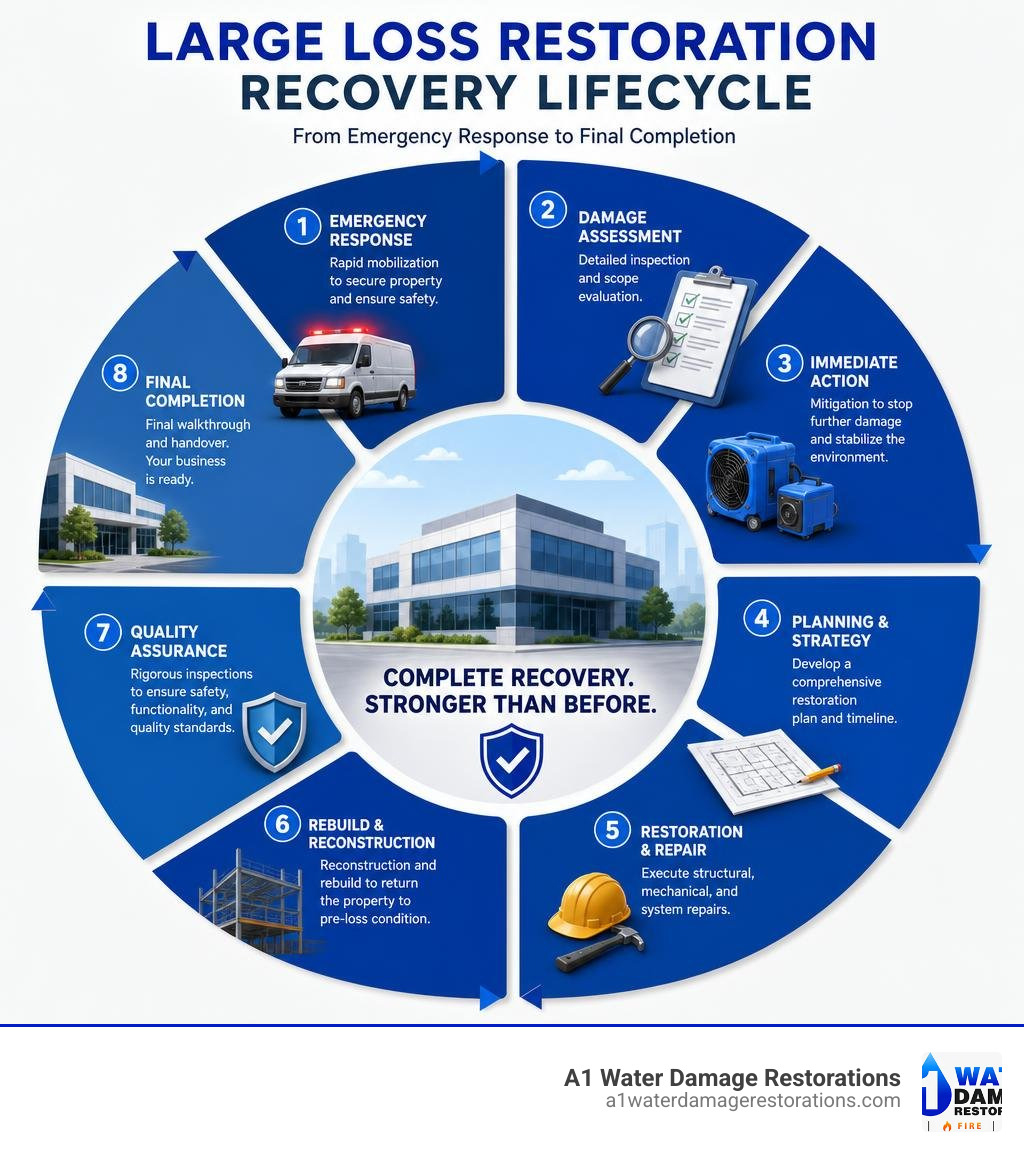
Essential large loss restoration terms:
What Defines a Large Loss Restoration Project?
When we talk about a large loss restoration project, we are not talking about a simple carpet dry-out after a minor breakroom sink leak. A true large loss is defined by both its massive financial impact and its operational complexity.
In the restoration and insurance industries, a large loss typically involves claims exceeding $100,000 in restoration scope. However, depending on the specific insurance carrier and the high-value markets we serve in places like Cherry Creek or Boulder, some carriers set their internal large loss thresholds at $250,000 or even higher. For partial or total losses in high-value commercial zones, these claims routinely climb from $200,000 to well over $1,000,000.
Beyond the dollar signs, a large loss is characterized by:
- Severe Operational Disruption: Your business cannot function. Employees cannot work, tenants are displaced, and revenue completely grinds to a halt.
- Multi-System Damage: The disaster has simultaneously compromised your structural framing, electrical systems, HVAC ductwork, and plumbing.
- Complex Logistics: Managing the recovery requires a massive, coordinated effort involving structural engineers, environmental hygienists, municipal code inspectors, and multiple specialty trades.
The Core Mechanics of Large Loss Restoration
Unlike standard residential work, the mechanics of a large-scale project require a highly structured management approach. We don’t just send a couple of technicians in a van. We establish an Incident Command System (ICS) structure on-site, led by a dedicated project director.
The immediate priorities focus on three core areas:
- Preserving Structural Integrity: Shoring up compromised walls, placing emergency roof tarps, and boarding up broken windows to secure the envelope.
- Environmental Controls: Deploying massive, industrial-scale climate control systems to manage indoor relative humidity and prevent secondary mold growth.
- Multi-Trade Coordination: Seamlessly managing plumbers, electricians, carpenters, and hazardous material specialists so that work happens in the correct, code-compliant sequence.
For properties throughout Denver, Arvada, and Littleton, having a team capable of executing these complex mechanics is the difference between a successful recovery and a prolonged business shutdown. You can learn more about how we structure these large-scale operations by reading our services/reconstruction page or exploring our comprehensive Services/Commercial Services options.
Common Causes and Building Complexities in Large-Scale Disasters
Large-scale disasters rarely have a single, simple consequence. When a major event occurs, it triggers a chain reaction of property damage across your entire facility.

In the Denver Metro Area, we see several primary drivers of these catastrophic events:
- Severe Storms and Wildfires: From heavy winter snow loads causing roof collapses in Golden to sudden summer hail and windstorms in Broomfield, Colorado weather can compromise a commercial building envelope in seconds.
- Commercial Fires: Kitchen fires in restaurants, electrical faults in office parks, or industrial accidents can cause widespread structural charring, heavy smoke contamination, and massive water damage from automatic sprinkler systems.
- Widespread Water Intrusion: A single burst water main on the top floor of a multi-story office building in Westminster can cascade thousands of gallons of water down through dozens of tenant spaces, soaking drywall, insulation, and subfloors along the way.
For specialized assistance in recovering from these fire-related events, you can view our Services/Fire Damage page.
How Building Characteristics Impact Large Loss Restoration
The physical characteristics of your building dictate exactly how complex—and expensive—your large loss restoration will be.
Consider the age of your property. According to EPA guidance, approximately 50 percent of US schools built before 1980 contain asbestos. The same risks apply to older commercial office buildings and retail spaces in historic areas of Denver, Littleton, and Boulder. If we are dealing with a pre-1980 structure, we cannot simply tear out wet drywall or charred ceiling tiles. We must perform mandatory hazardous material testing first. If asbestos or lead-based paint is present, we must execute strict containment and abatement protocols before any structural drying or demolition can begin.
Furthermore, local building codes in municipalities like Westminster or Greenwood Village require that any rebuilt structures be brought up to current codes. If your older building suffers a major loss, the reconstruction phase may require mandatory upgrades to your electrical, plumbing, or fire suppression systems, which must be carefully documented for your insurance carrier.
To see how we navigate these localized municipal guidelines, you can read about our comprehensive Services/Commercial Services options or contact our team directly to discuss how we handle local building codes in Westminster, Greenwood Village, and throughout the Denver Metro Area.
The Step-by-Step Large Loss Recovery Timeline
A large-scale restoration project is a marathon, not a sprint. While we strive to work as quickly as possible to minimize your operational downtime, a realistic timeline for a high-value commercial or residential large loss typically spans 6 to 18 months from the initial event to final handover.
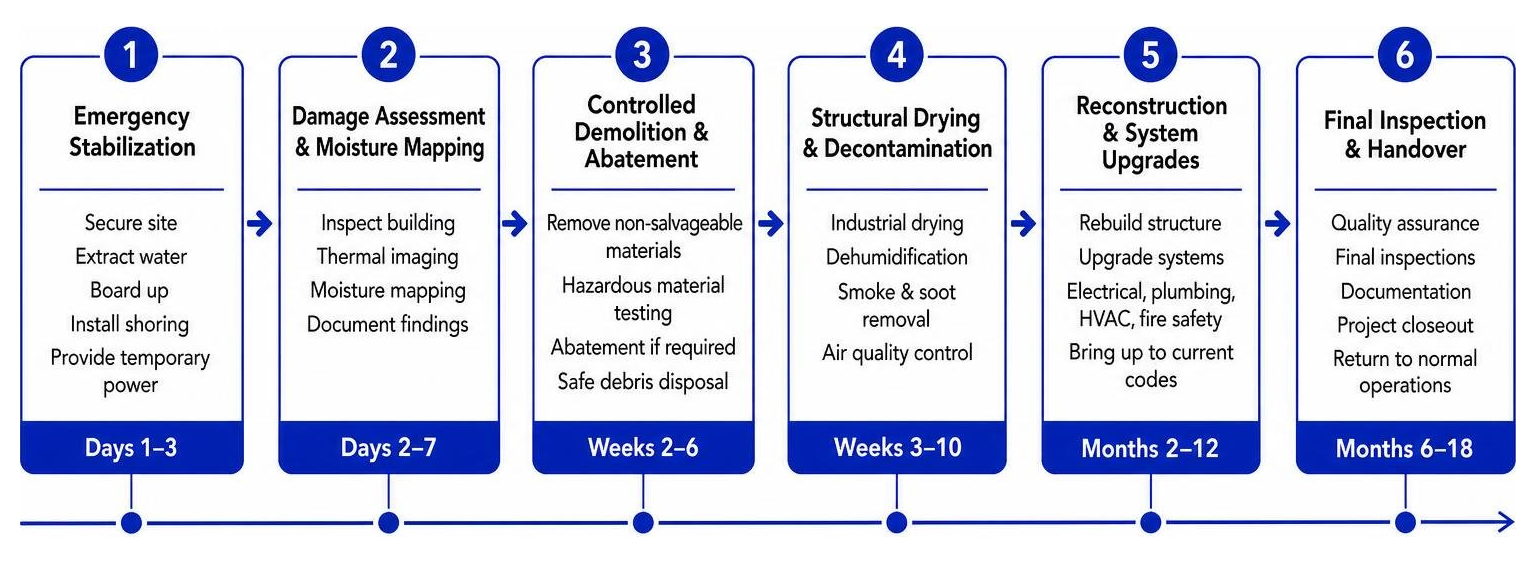
Here is how the recovery process unfolds phase by phase:
- Emergency Stabilization (Days 1–3): Our immediate goal is to secure the site. We perform rapid water extraction, board up exposed areas, install temporary structural shoring, and set up temporary power generators.
- Damage Assessment & Moisture Mapping (Days 2–7): We use calibrated thermal imaging cameras, pinless moisture meters, and industrial hygrometers to map out the exact migration of water and smoke throughout the building.
- Controlled Demolition & Abatement (Weeks 2–6): Non-salvageable materials—such as saturated insulation, ruined ceiling tiles, and contaminated drywall—are carefully removed. If hazardous materials are found, certified abatement occurs during this window.
- Structural Drying & Environmental Control (Weeks 2–8): We deploy high-capacity, trailer-mounted desiccant dehumidifiers capable of processing 10,000 or more cubic feet of air per minute (CFM). These industrial units are essential for drying deep structural concrete, subfloors, and large open spaces.
- Insurance Approval & Estimating (Weeks 2–12): We work side-by-side with your insurance adjuster, submitting detailed line-item estimates to secure scope approval before major reconstruction begins.
- Reconstruction & Finish Work (Weeks 8–52+): This is the rebuilding phase. We handle everything from framing and electrical rough-ins to custom millwork, flooring, painting, and final code inspections.
To understand the rebuilding phase in greater detail, read our guide on Everything You Need To Know About Property Reconstruction.
Navigating Budgets, Estimating, and Insurance Coordination
One of the biggest pitfalls in large-scale restoration is financial mismanagement. It is incredibly easy for a massive project to spiral out of control if the budget isn’t built correctly from day one. In fact, industry data shows that 40.8% of restoration companies name “getting paid” as their number-one operational problem, which is almost always a direct result of poor initial documentation and estimating mistakes.
To prevent this, we do not treat our initial numbers as a final, rigid invoice. Instead, we present a Rough Order of Magnitude (ROM) estimate within the first 24 to 48 hours. A ROM estimate establishes a realistic budget range based on the square footage and visible damage, setting clear expectations for both you and your insurance carrier before we mobilize heavy equipment.
We build our commercial estimates using a “labor-first” calculation:
$$text{Baseline Crew Size} = frac{text{Total Affected Square Footage} div text{Daily Production Rate Per Person}}{text{Required Working Days}}$$
Once we establish this baseline, we layer in specialized project managers, safety officers, and equipment technicians. This highly structured methodology ensures we don’t overstaff the job (which raises red flags with insurance auditors) or understaff it (which delays your reopening).
We write all of our final estimates using Xactimate, the industry-standard software used by major insurance carriers. This ensures our line items align perfectly with what your insurer expects to see, helping to prevent scope disputes that can add 30 to 90 days of unnecessary delays to your project. For a deeper dive into how these complex budgets are constructed and why some projects fail financially, check out this expert analysis on Why Large-Loss Jobs Go Over Budget Before Day One.
Proactive Disaster Planning: The Power of Pre-Loss Agreements
The absolute worst time to try and find a qualified commercial restoration partner is at 2:00 AM on a freezing Tuesday in January when a water main has just burst and is flooding your retail center in Broomfield.
In the middle of a regional disaster—like a severe winter freeze or a major windstorm—local restoration resources get stretched incredibly thin. If you don’t have a pre-existing relationship with a provider, you could be left waiting days just for an initial inspection.

This is why we highly recommend establishing a Pre-Loss Agreement (also known as an Emergency Response Agreement) before disaster strikes. A Pre-Loss Agreement is a zero-cost risk management tool that outlines exactly how we will respond if your property suffers a loss.
When you set up an agreement with us, we perform a comprehensive walk-through of your facility to document:
- The exact location of all main utility shut-offs (water, gas, electricity) with clear photos.
- Key building contacts, security access protocols, and tenant coordination plans.
- Specialized equipment requirements based on your building’s unique layout.
In return, you receive priority dispatch status. If a major storm hits the Denver Metro Area, our team is committed to responding to your property first, bypassing the non-contracted queue.
To see how we implement these emergency response strategies for businesses in our northern service areas, you can read The Ultimate Guide To Emergency Restoration In Broomfield Co.
Frequently Asked Questions About Large-Scale Property Damage
What is the difference between a national restoration firm and a local specialist?
When facing a major disaster, many property managers assume they have to call a massive, national franchise network to get the resources they need. However, choosing a national firm vs. a local specialist involves distinct trade-offs.
National firms certainly have large equipment pools, but they often struggle with local logistics. Their out-of-state crews may not understand the specific building codes of Denver, Westminster, or Littleton, and their decision-making chain can be slow and bureaucratic.
As a local, family-owned specialist, we provide the best of both worlds. We live and work in the Denver Metro Area, meaning we can be on-site within hours of your call. We maintain our own local fleet of industrial equipment, and because we are family-owned, you get a direct line of communication to our leadership team without any corporate red tape. Local specialists are typically much better positioned to navigate municipal codes and provide rapid, hands-on support compared to national response frameworks.
How long does a typical commercial large loss project take to complete?
As a general rule, expect a large-scale commercial restoration to take anywhere from 6 to 18 months.
The physical cleanup and structural drying can usually be completed in the first few weeks. The real bottleneck is almost always the reconstruction phase. Custom commercial materials—such as specialized HVAC units, commercial-grade electrical panels, custom millwork, or imported finishes—frequently carry lead times of several months. Additionally, securing municipal building permits and waiting for structural engineering approvals can add significant time to the schedule.
What are the most common misconceptions about large-scale property damage?
- Misconception 1: “We have plenty of time to deal with the water.” Many building owners think they can wait a few days to resolve insurance paperwork before starting the drying process. However, the IICRC S500 Standard explicitly states that the first 24 to 48 hours represent the critical threshold before secondary microbial growth (mold) begins on Category 1 water losses. Delaying mitigation will dramatically increase your costs and timeline.
- Misconception 2: “The building structure is the most expensive part of the loss.” Sizable structural damage is costly, but contents losses in commercial events frequently represent 40% to 60% of the total insured value. Saturated documents, ruined inventory, and contaminated electronics add up incredibly fast.
- Misconception 3: “FEMA will step in and pay for our commercial recovery.” FEMA programs do not fund private commercial property restoration. Recovery for private businesses must route through your commercial property insurance policy.
- Misconception 4: “Restoring a complex system is just like fixing a simple physical structure.” Actually, modern restoration is highly technical. Just as computer scientists discuss Restoring Pruned Large Language Models via Lost Component Compensation to recover lost data performance in artificial intelligence, physical restoration specialists must use advanced engineering principles to compensate for lost structural integrity and restore complex, multi-layered building systems back to peak performance.
Conclusion
A large loss event is one of the most stressful challenges any business owner or property manager will ever face. The sheer scale of the damage, the financial pressure of business interruption, and the complexity of the insurance claims process can easily feel overwhelming.
But you do not have to navigate this recovery alone.
At A1 Water Damage Restorations, we provide 24/7, IICRC-certified water, fire, and mold restoration across the entire Denver Metro Area—including Boulder, Cherry Creek, Denver, Golden, Greenwood Village, Arvada, Westminster, Wheatridge, Broomfield, and Littleton. As a family-owned, local business, we combine the heavy-duty industrial equipment and technical expertise of a national firm with the warm, personalized touch and swift action that only a local partner can deliver.
We don’t just clean up the mess; we manage the entire project from initial stabilization to final reconstruction, ensuring your property is restored better than ever.
If you want to protect your business before disaster strikes, or if you are currently facing a property emergency, we are here to help. Schedule a commercial consultation with our team today, and let us help you build a resilient strategy for your property.