

How Commercial Restoration Companies Help Protect Your Business
When water, fire, mold, or storm damage affects a business, commercial restoration companies provide emergency mitigation, cleanup, documentation, and rebuilding support. Look for a provider that can respond 24/7, has IICRC-certified technicians, uses commercial-grade drying and cleaning equipment, and can coordinate directly with your insurance carrier.
Fast action matters because the first priority is to stop damage from spreading, protect people and inventory, and limit costly downtime. A qualified restoration team can often work evenings or weekends, create containment around affected areas, and phase work so parts of your property can remain open when it is safe to do so.
This guide explains how to compare restoration partners, understand insurance documentation, and prepare your property before the next loss occurs.
I am Cole Nudel, a disaster restoration professional with A1 Water Damage Restorations in the Denver area. My work with commercial restoration companies and property-damage recovery helps owners navigate urgent losses with clearer next steps.
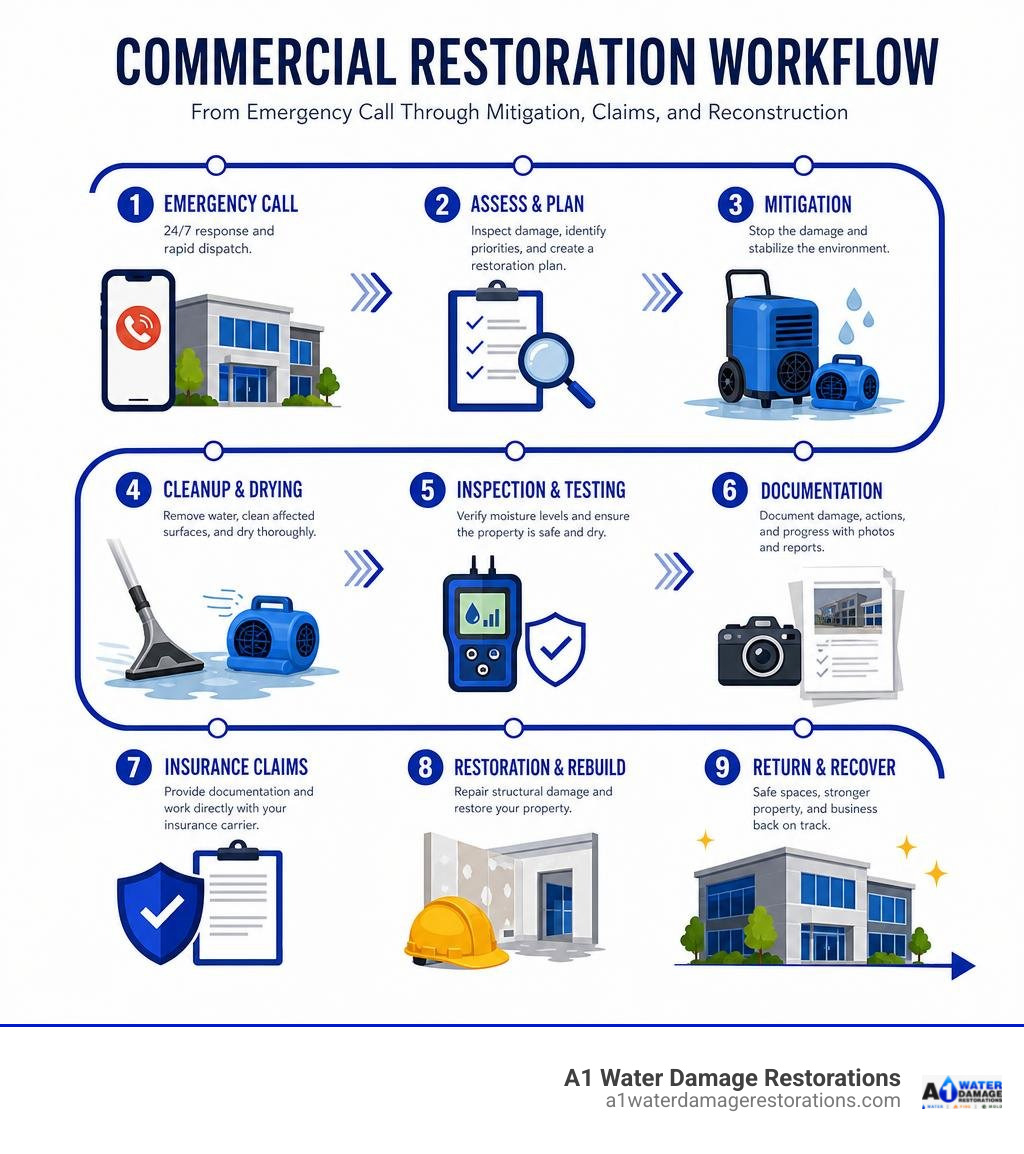
Quick commercial restoration companies definitions:
Core Services Provided by Commercial Restoration Companies
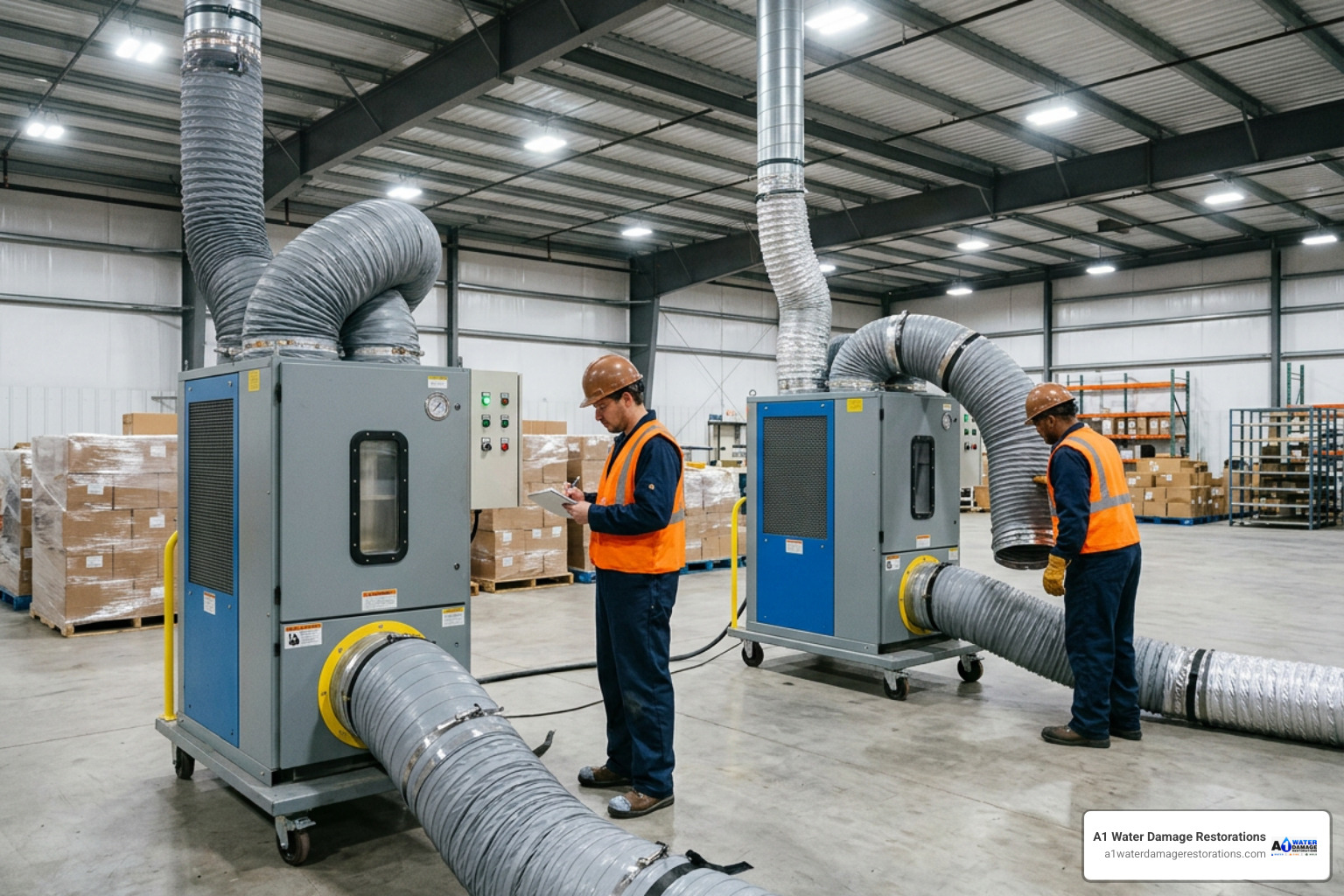
Commercial restoration goes far beyond standard janitorial cleanup. When a catastrophic pipe burst, fire, or severe storm hits a commercial facility, businesses face immediate revenue loss, structural risks, and strict regulatory hurdles. As a family-owned team serving communities across Denver, Boulder, Littleton, and Broomfield, we deliver comprehensive, in-house emergency solutions to keep your business operating safely.
Water, Flood, and Storm Mitigation
Water is one of the most common threats to commercial properties. Whether dealing with a multi-story supply line break or seasonal flash flooding, understanding commercial water damage causes helps mitigate ongoing risk.
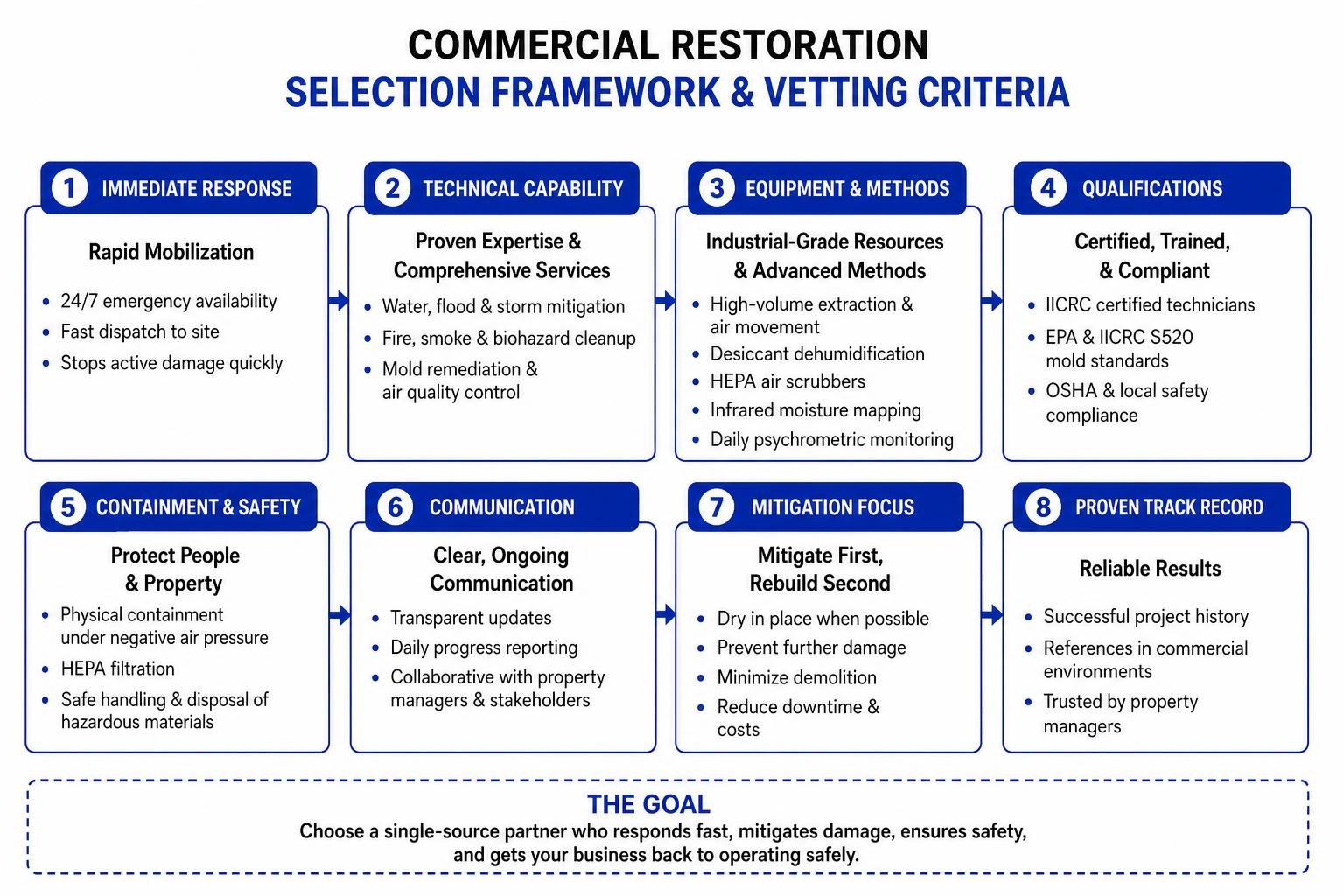
Our emergency crews utilize heavy-duty extraction equipment, high-volume air movers, and industrial desiccant dehumidifiers to stabilize the environment. Desiccant units pull deeply embedded moisture out of concrete, drywall, and structural framing while keeping noise outside your workspace. Throughout the drying process, we perform daily psychrometric monitoring to track relative humidity, temperature, and moisture levels across all affected materials.
Severe weather events also require immediate exterior stabilization. Following high winds or hail storms, our teams manage emergency board-up, roof tarping, and building envelope repair. Hail damage can compromise flat roofs, HVAC units, and siding, making timely assessment of commercial roofing hail damage critical to prevent interior collapse. To speed up recovery in retail shops, automotive centers, and warehouses, deploying specialized equipment such as a commercial hot water extractor ensures deep extraction and thorough sanitization across commercial flooring.
Fire, Smoke, and Biohazard Cleanup
A commercial fire creates widespread damage through heat, corrosive soot, smoke odor, and the thousands of gallons of water used during firefighting efforts. Fire mitigation requires:
- Corrosion Control: Acidic soot particles settle quickly on metal fixtures, electronics, and machinery, causing irreversible etching if not neutralized immediately.
- Thermal Fogging & Hydroxyl Treatment: Eliminating pervasive smoke odors from porous structural framing, upholstery, and inventory without leaving chemical residues.
- Duct Cleaning: Removing soot deposits from HVAC air handlers and ductwork to prevent cross-contamination when systems restart.
- Biohazard & Chemical Decontamination: Safely containing, removing, and disposing of hazardous materials, sewage backups, or trauma scenes in full compliance with OSHA and local safety standards.
Certified Mold Remediation and Air Quality Control
Commercial mold growth compromises indoor air quality and threatens tenant health. Following water intrusion or undetected humidity spikes, mold can spread behind drywall, under subfloors, and within HVAC ductwork in as little as 24 to 48 hours.
We follow strict EPA guidelines and IICRC S520 remediation standards. This includes setting up physical containment barriers under negative air pressure, running HEPA air scrubbers, and mapping hidden moisture pockets with infrared thermal cameras. For detailed facility protocols, review our commercial mold remediation guide to learn how we remediate contamination without spreading spores into adjacent occupied offices.
Key Criteria for Evaluating Commercial Restoration Partners
When disaster strikes your commercial facility in Golden, Arvada, or Cherry Creek, you need a partner capable of immediate mobilization. Vetting contractors beforehand ensures you choose a team with adequate equipment, trained technicians, and an established track record. Understanding how to find commercial restoration services gives property managers the leverage to secure reliable single-source support before emergencies happen.
Why Top Commercial Restoration Companies Prioritize Mitigation Over Reconstruction
A successful restoration outcome hinges on fast, focused mitigation. Emergency mitigation stops active damage, salvages structural materials, and limits unnecessary demolition. By drying structures in place rather than tearing down walls and flooring, businesses save substantial capital expenditure and shave weeks off operational downtime.
| Restoration Phase | Primary Objective | Key Actions Performed | Business Impact |
|---|---|---|---|
| Emergency Mitigation | Halt active damage, stabilize building environment, and prevent secondary loss. | Water extraction, psychrometric drying, structural shoring, soot removal, containment barriers. | Minimizes structural demolition, protects tenant assets, and significantly reduces insurance claim costs. |
| Structural Reconstruction | Restore the building shell, interior fixtures, and architectural finishes to pre-loss state. | Framing, drywall installation, electrical/plumbing rough-ins, painting, and flooring replacement. | Requires building permits, extended timelines, and capital expenditure for non-salvaged items. |
Industry Certifications, Response Times, and After-Hours Protocols
Restoration work in commercial environments demands rigorous technical training. Look for technicians holding certifications from the Institute of Inspection, Cleaning and Restoration Certification (IICRC), including Applied Structural Drying (ASD), Water Damage Restoration (WRT), and Fire & Smoke Restoration (FSRT).
Because business operations cannot simply stop, top restoration companies offer off-hours and weekend deployment. Utilizing acoustic dampening panels around equipment, dust barriers, and zoned staging allows crews to work overnight while your team continues serving customers during standard business hours.
How Commercial Restoration Companies Manage Complex Insurance Claims
Filing a commercial property claim requires precise documentation. Professional restoration teams simplify this process by using industry-standard estimation platforms like Xactimate and providing adjusters with real-time digital proof.
Our project managers compile complete claim packets that include:
- Initial thermal imaging and visual damage logs.
- Daily psychrometric monitoring logs proving drying progression.
- Itemized inventories of unsalvageable contents with photographic evidence.
- Direct alignment with commercial adjusters to verify local code compliance and support business interruption coverage claims.
Commercial Property Damage Coverage and Readiness Planning
Understanding your insurance policy limits before disaster strikes prevents unexpected out-of-pocket costs and speeds up facility recovery.
Navigating Commercial Insurance Coverage and Exclusions
Commercial property policies protect your physical plant, inventory, and operational income, but specific perils carry notable exclusions:
- Typically Covered: Sudden burst pipes, electrical fires, structural smoke damage, windstorm impact, and vehicle impacts on the building envelope.
- Common Exclusions & Endorsements: Rising overland flood waters require separate flood insurance. Backup of sewers and drains typically requires a specific policy rider, while losses stemming from long-term deferred maintenance or gradual foundation seepage are routinely denied.
Building an Emergency Disaster Readiness Plan
An Emergency Disaster Readiness Plan (ERP) provides facility directors, property managers, and engineers with a step-by-step roadmap when crises occur.
- Primary Utility Shutoffs: Detailed site maps identifying main water valves, gas shutoffs, and electrical breaker panels.
- Priority Service Agreements: Pre-arranged contracts with a certified restoration company to secure priority dispatch during regional disaster events.
- Digital Asset & Data Redundancy: Off-site cloud backup procedures for core company servers and financial records.
- Critical Contact Rosters: Updated directories of internal response coordinators, local utility providers, and emergency responders.
- Phased Evacuation & Re-entry Protocols: Safe evacuation procedures, building access guidelines, and designated operational staging areas.
Frequently Asked Questions About Commercial Property Restoration
How quickly can a restoration crew respond to a commercial emergency?
Our dispatch teams operate 24/7/365, mobilizing emergency crews to locations throughout Denver, Westminster, Wheatridge, and Greenwood Village within hours of your call to contain damage immediately.
Can restoration work proceed after hours to avoid operational downtime?
Yes. Evening, overnight, and weekend shifts are standard practice for commercial properties. We deploy low-noise equipment and containment barriers so your facility can maintain regular daytime operations safely.
How do restoration contractors handle large multi-building losses?
Large multi-facility losses require organized staging areas, heavy mobile power generators, desiccant trailer units, and high-capacity truck-mounted extractors. Our project managers coordinate alongside industrial hygienists and facility engineers to systematically manage large loss restoration from initial containment through complete turnover.
Conclusion
When property damage threatens your business operations, partnering with an experienced, locally owned restoration contractor ensures your facility is stabilized quickly and restored to pre-loss condition. From 24/7 emergency water extraction to full structural rebuilds, having certified experts on your side minimizes revenue disruption and protects your long-term capital investment.
Ready to protect your commercial property or need immediate emergency response? Explore our comprehensive commercial restoration services or contact our team today to develop a customized disaster readiness plan for your facility.