

What Fire Damage Restoration Involves
After a fire, wait until officials say the property is safe to enter. Then document the damage, secure exposed areas, and call a fire restoration professional. The work may include removing firefighting water, cleaning soot and smoke residue, treating odors, saving belongings, and repairing damaged parts of the building.
Fire remediation focuses on removing hazards and contamination. Fire damage restoration includes that work, plus the repairs needed to make the property usable again. Even rooms the flames never reached may need attention if smoke traveled through them.
I’m Cole Nudel, and I work in disaster restoration with A1 Water Damage Restorations in the Denver area. I help property owners restore fire damage safely and understand the cleanup, repair, and insurance steps ahead. When recovering after a blaze, the process follows a clear sequence from emergency stabilization through final reconstruction.
Helpful emergency restoration resources:
Understanding Fire Damage Restoration vs. Remediation and the ANSI/IICRC S700 Standard
Experiencing a property fire is overwhelming, and navigating the aftermath requires clear distinctions between different recovery phases. While people often use the terms interchangeably, fire remediation and fire restoration represent two distinct scopes of work.
- Fire Remediation: This phase is all about containment, safety, and decontamination. It involves extracting suppression water, removing charred structural debris, scrubbing indoor air, and eliminating acidic soot deposits. Remediation stops progressive decay and makes the structure safe for human occupancy.
- Fire Damage Restoration: This is the complete, end-to-end recovery process. It encompasses initial remediation as well as full-scale reconstruction, structural repairs, contents recovery, aesthetic refinishing, and complete odor elimination. Restoration returns your property to its pre-loss condition—or better.
Knowing how to choose the best fire restoration company in Denver requires looking for teams certified by the Institute of Inspection, Cleaning and Restoration Certification (IICRC). Qualified technicians possess the specialized training required to assess structural integrity, handle dangerous off-gassing, and restore healthy indoor air quality.
The Regulatory Framework: What ANSI/IICRC S700 Establishes
Professional fire recovery is governed by standard-of-care frameworks. The American National Standard for Professional Fire and Smoke Damage Restoration establishes the benchmark protocols for our industry. According to the Fire Damage Restoration Guide (S700, 2026), this standard outlines how certified teams must assess, stabilize, clean, and document structural fire losses.
Under these guidelines, technicians must follow strict safety release criteria before entering a structure, construct formal Restoration Work Plans, and establish measurable clearance thresholds for soot and odor removal.
Smoke Chemistry and Residue Classifications
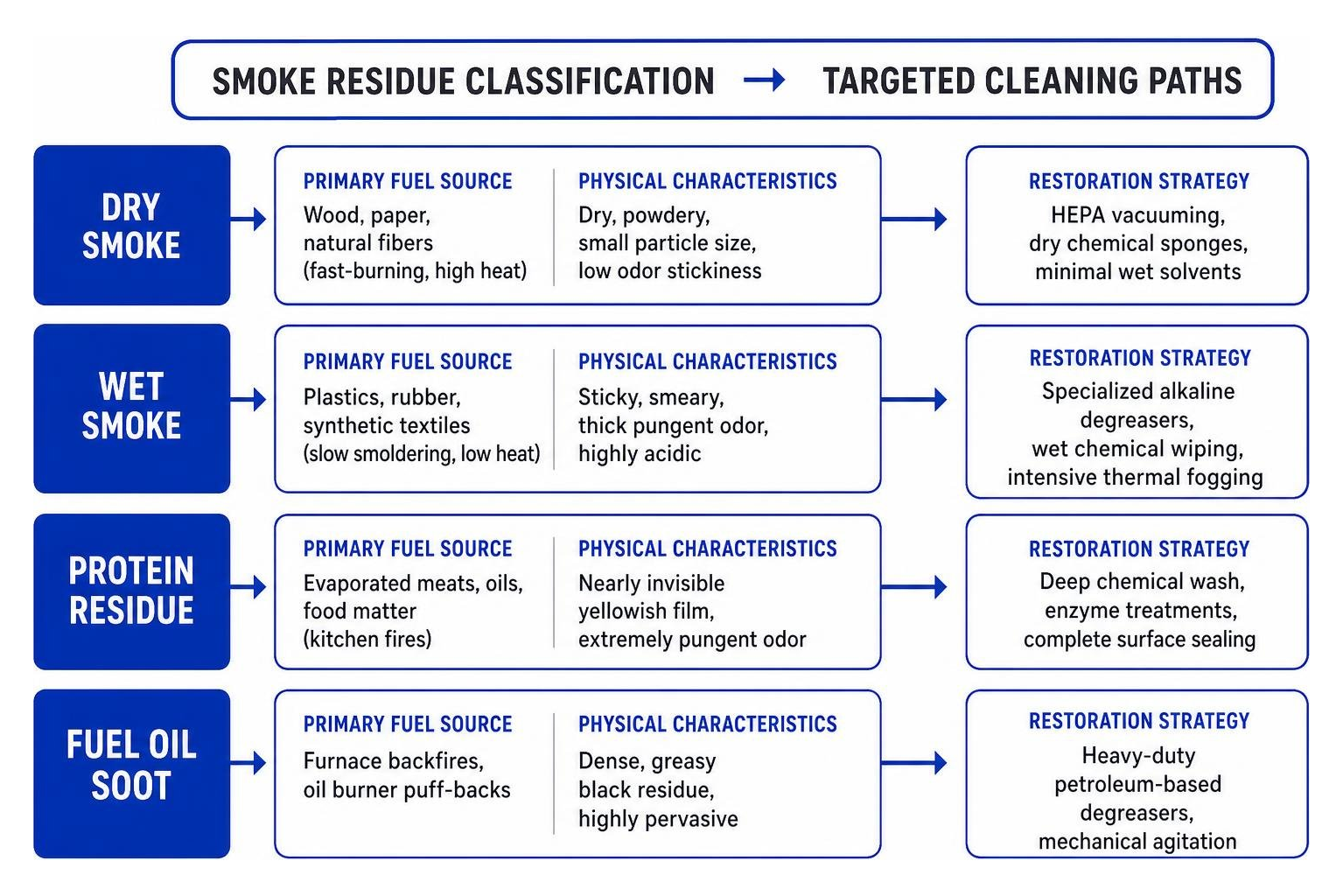
Fire does not generate just one type of smoke. Depending on the fuel source, available oxygen, and burning temperature, fires produce radically different residues that require specialized chemical neutralizing agents.
| Smoke Residue Type | Primary Fuel Source | Physical Characteristics | Restoration Strategy |
|---|---|---|---|
| Dry Smoke | Wood, paper, natural fibers (fast-burning, high heat) | Dry, powdery, small particle size, low odor stickiness | HEPA vacuuming, dry chemical sponges, minimal wet solvents |
| Wet Smoke | Plastics, rubber, synthetic textiles (slow smoldering, low heat) | Sticky, smeary, thick pungent odor, highly acidic | Specialized alkaline degreasers, wet chemical wiping, intensive thermal fogging |
| Protein Residue | Evaporated meats, oils, food matter (kitchen fires) | Nearly invisible yellowish film, extremely pungent odor | Deep chemical wash, enzyme treatments, complete surface sealing |
| Fuel Oil Soot | Furnace backfires, oil burner puff-backs | Dense, greasy black residue, highly pervasive | Heavy-duty petroleum-based degreasers, mechanical agitation |
The Step-by-Step Protocol to Restore a Fire-Damaged Property
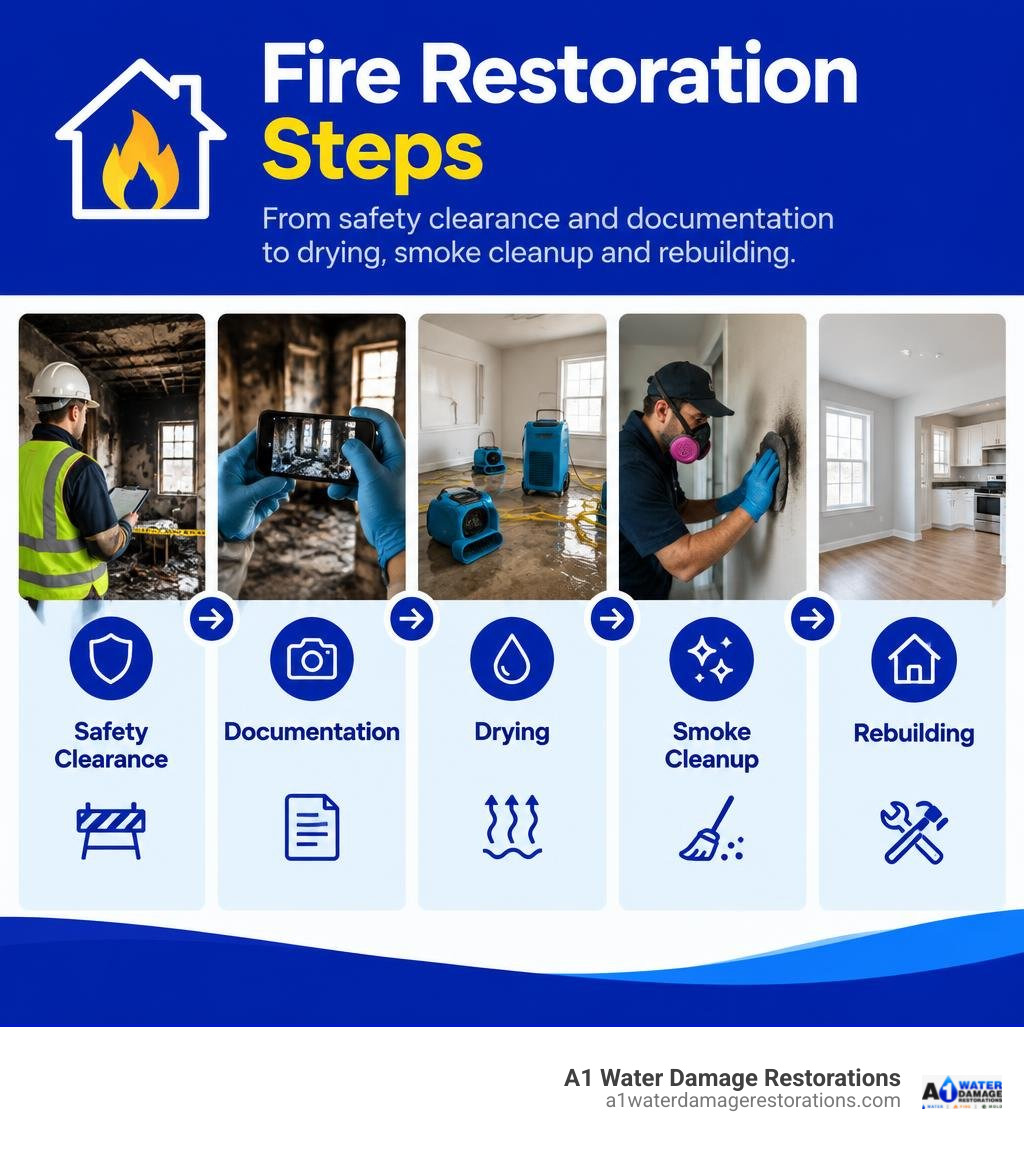
Restoring a fire-damaged property is a systematic, phased operation designed to prevent cross-contamination and rebuild safely.
Phase 1: Stabilization, Emergency Water Extraction, and Containment
The clock begins the moment fire rescue teams hand over the scene release. Our priority is immediate stabilization:
- Safety Walk & Structural Shoring: Verifying structural safety before interior operations begin.
- Emergency Board-Up & Tarping: Sealing broken windows, doors, and compromised roof assemblies to secure the building against weather and trespassers.
- Water Removal: Thousands of gallons of water are often pumped into a structure during firefighting efforts. We immediately extract standing water using truck-mounted units.
- Customer Fire Bag Preparation: We help homeowners immediately retrieve and inventory day-one essentials, including:
- Personal identification, passports, and essential banking paperwork
- Daily medications and medical equipment
- House and vehicle keys
- Phone chargers, essential electronics, and laptops
- A three-day change of clothing and basic hygiene supplies
Phase 2: Soot Removal, HVAC Decontamination, and Odor Neutralization
Soot is chemically active and acidic. Following a step-by-step guide to smoke damage restoration ensures that soot is removed systematically without driving particles deeper into porous substrates:
- Dry Chemical Sponges: Used on porous walls and ceilings to lift dry particulates before any liquid solvents touch the surface.
- HVAC Remediation: Sealing and decontaminating ductwork to prevent the mechanical distribution of soot throughout non-flame zones.
- Advanced Deodorization: Utilizing industrial hydroxyl generators, ozone chambers (in unoccupied spaces), and thermal fogging to chemically alter and eliminate volatile organic compounds (VOCs).
Phase 3: Salvaging Belongings Through Contents Pack-Out
Salvaging personal belongings requires careful care and tracking. Through our contents restoration services, affected items are carefully cataloged with digital barcoding, packed, and transported to our climate-controlled facility.
At our facility, soft goods undergo specialized ozone and hydraulic washing, delicate hard goods receive ultrasonic bath treatments, and electronics are disassembled, cleaned of corrosive soot, and tested.
Phase 4: Structural Repair and Final Rebuild
Once remediation is certified complete, full structural repairs begin:
- Char Removal & Blasting: Employing dry ice or soda blasting on structural framing to remove char down to sound, unburned wood.
- Odor Barrier Sealing: Applying specialized shellac-based encapsulants over framing members to permanently lock in any trace microscopic odor.
- Reconstruction: Replacing framing, hanging new drywall, installing flooring, finishing trim, and completing all interior painting to return the home to pristine condition.
Critical Timelines: How Smoke and Suppression Water Cause Secondary Damage
Time is the biggest variable dictating overall recovery costs after a fire. The chemical interactions between heat, acidic soot, and moisture accelerate rapidly.
The Secondary Damage Clock: Minutes to Weeks
- Within Minutes to 1 Hour: Acidic soot begins reacting with smooth surfaces, causing yellowing on synthetic plastics and etching on glass and polished metals.
- Within 24 to 48 Hours: Unfinished metals pit and corrode permanently; grout, fiberglass, and appliances suffer deep chemical discoloration.
- Within Days to Weeks: Acid soot penetrates deep into structural wood framing, flooring substrates, and porous finishes, making replacement necessary where cleaning might have once worked.
Addressing Firefighting Water Intrusion Before Mold Sets In
Fire suppression water does not stay clean; it dissolves chemical residues, soot, and structural building materials, quickly becoming Category 3 (black) water. Successfully restoring your home after fire and water damage requires rapid moisture mapping and high-volume psychrometric dehumidification to prevent microbial mold colonies from blooming within 48 to 72 hours.
Clean vs. Replace Decisions and Insurance Claim Documentation
One of the most complex elements of property recovery is determining what can be saved versus what must be replaced.
When to Clean vs. Rebuild to Restore Fire-Damaged Interior Materials
Our field teams perform detailed assessments to determine restorability thresholds:
- Drywall & Insulation: Unpainted drywall exposed to heavy wet smoke or saturated with suppression water must be replaced. Dry, surface-level soot on sealed drywall can often be chemically cleaned and repainted. Blown-in or batt insulation acts like a sponge for smoke particulates and is always removed and replaced.
- Structural Framing: If charring has penetrated more than structural load limits allow, framing members must be sistered or replaced. If charring is superficial, media blasting and encapsulating allow us to preserve the original structure.
- Cabinetry and Trim: Solid hardwood can often be stripped, sanded, and refinished. Particle board and laminate cabinetry swollen from heat or suppression water require replacement.
Best Practices to Secure Claim Approvals with Accurate Scoping
To ensure smooth claim approvals, we provide insurance adjusters with comprehensive, itemized line-item scoping. Understanding fire and water damage mitigation costs comes down to precise documentation:
- Timestamped photo and video logs of all rooms and hold points
- Detailed thermal imaging and moisture meter mapping logs
- HVAC air distribution assessments documenting smoke migration
- Comprehensive non-salvageable contents inventories with replacement value research
Frequently Asked Questions About Fire Restoration
How long does fire damage restoration take from start to finish?
A minor, contained smoke loss involving one or two rooms typically takes 1 to 2 weeks for complete cleaning and deodorization. Medium-scale losses requiring structural remediation, contents pack-out, and drywall repairs average 1 to 2 months. Severe, large-scale structural fires requiring complete framing rebuilds, permitting, and architectural reconstruction generally take 3 to 6 months or longer.
Can you stay in your home during fire and smoke damage restoration?
In most cases, no. Even if flames were confined to a single room, fine soot particles, carbon monoxide residues, and toxic VOCs circulate freely through open pathways and HVAC systems. Living in the property during remediation exposes occupants to respiratory hazards. Most homeowners insurance policies include Additional Living Expenses (ALE) coverage to pay for temporary housing while our team completes the work.
Does homeowner insurance cover smoke cleanup in rooms without flame damage?
Yes. Standard homeowner policies cover direct physical losses caused by fire, which legally includes smoke migration. If smoke, soot, or hot gases travel through hallways or HVAC ductwork into rooms completely untouched by open flames, the cleaning, deodorization, and repainting of those areas are covered under your claim.
Conclusion
Recovering from a property fire requires rapid, methodical, and certified expertise. From emergency board-up and standing water extraction to advanced soot decontamination and complete structural rebuilding, every step is critical to protecting your health and restoring your property’s value.
At A1 Water Damage Restorations, we serve families and businesses across Denver, Boulder, Cherry Creek, Golden, Greenwood Village, Arvada, Westminster, Wheat Ridge, Broomfield, and Littleton. As an IICRC-certified, family-owned team, we are ready 24/7 to help you rebuild. Contact us today to access our professional emergency restoration services and bring your property back better than ever.