

Who Pays for Condo Water Damage: HOA or Owner?
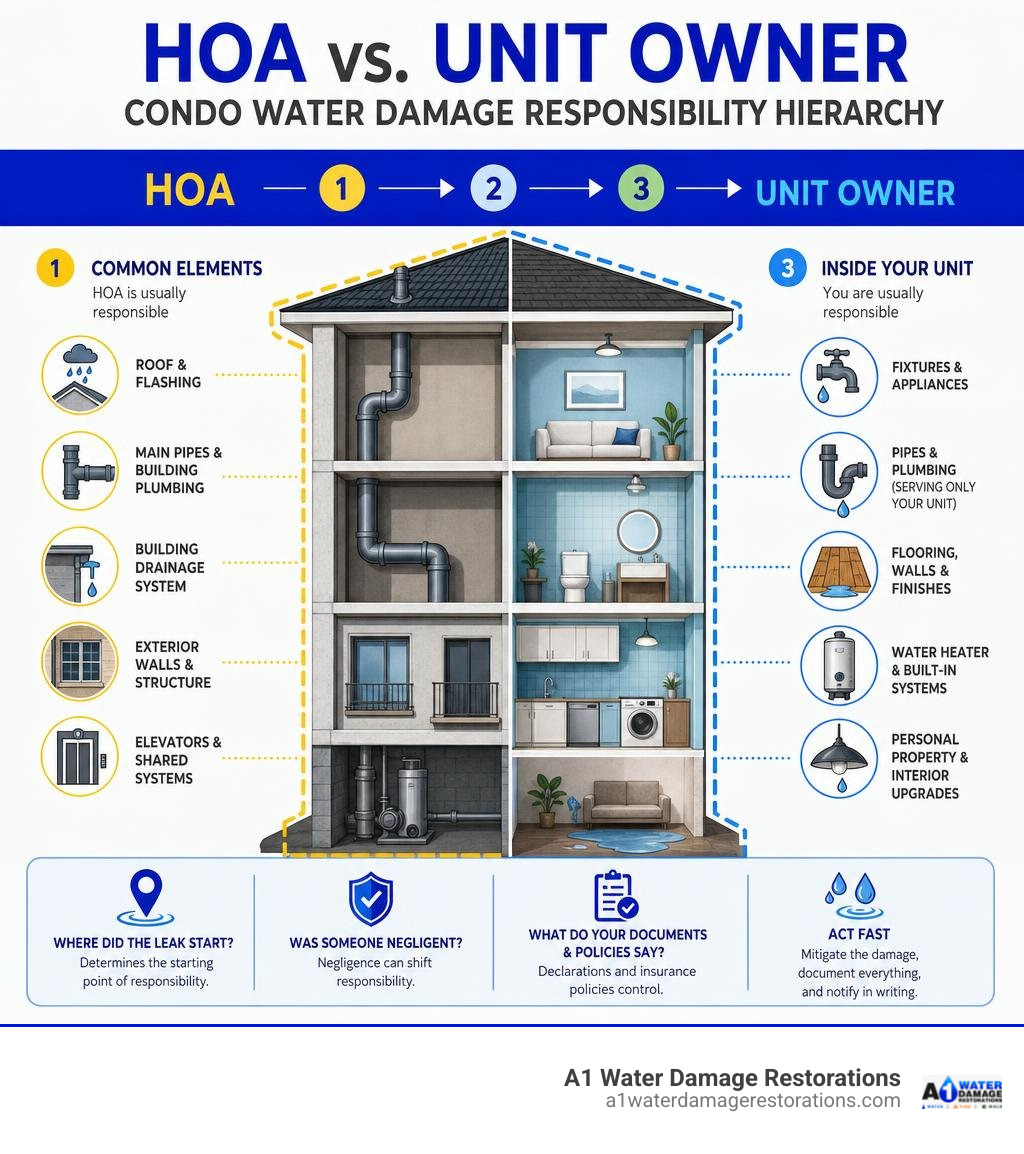
The HOA usually handles water damage caused by a common element, such as a shared roof, main pipe, or building drainage system. You are usually responsible for damage from inside your unit, including your appliances, fixtures, and plumbing that serves only your home. But the final answer depends on three things: where the leak started, whether someone was negligent, and what your declaration and insurance policies say.
If water is actively spreading, do not wait for the liability decision. Shut off the water if it is safe, notify the HOA or property manager in writing, photograph everything, and contact your insurer and a qualified restoration company. Wet drywall, flooring, and cabinets can develop mold within days.
In most cases:
- Common-element failure: The HOA may be responsible for repairs under the master policy and condominium documents.
- Leak inside your unit: Your HO-6 condo policy may cover sudden, accidental damage, subject to its deductible and limits.
- Neighbor’s careless act: The neighbor may be liable if negligence caused the loss, but your insurer may still help pay for your damage first and seek reimbursement later.
- Slow leak, sewer backup, or floodwater: Standard policies often exclude these losses unless you have the right endorsement or separate flood coverage.
I am Cole Nudel, a disaster restoration professional with A1 Water Damage Restorations in the Denver area. I help property owners navigate urgent condo water damage, from early moisture concerns to the drying, documentation, and recovery work that follows.
Condo water damage word roundup:
Understanding Liability for Condo Water Damage: HOA vs. Unit Owner
Living in a multi-family property like a condominium means sharing walls, plumbing risers, roofs, and drainage systems with dozens of neighbors. When moisture strikes, determining who pays requires untangling legal frameworks, insurance policies, and factual timelines. Water mitigation principles are thoroughly explored in The Definitive Guide to Residential Water Damage, but condos introduce an extra layer of governing bylaws.
Condo water damage liability generally hinges on two core legal tests: property ownership boundaries and the standard of negligence. Merely being the owner of the unit where a leak originated does not automatically make you liable under the law for damages to neighboring properties. For liability to stick, the injured party or the HOA typically has to prove negligent maintenance, an intentional act, or a clear violation of association rules.

The Declaration of Condominium and Boundary Rules
Every condominium community is governed by its Covenants, Conditions, and Restrictions (CC&Rs) and the master Declaration of Condominium. This recorded legal document defines the exact geographic boundaries of your private real estate versus the association’s shared property.
In most standard declarations:
- Unit Boundaries: The private unit often begins at the interior unpainted surface of the drywall, ceiling, and subfloor. Anything from the paint inward—such as wallpaper, baseboards, hardwood flooring, and light fixtures—is private property.
- Common Elements: Structural load-bearing framing, exterior brick, roof decks, foundations, and central utility lines are shared property owned collectively by all co-owners and managed by the HOA.
- Limited Common Elements: Balconies, patios, or designated exterior storage units may be reserved for your exclusive use, yet their maintenance and repair obligations are often split between you and the board.
When evaluating an intrusion, your first step after stopping the flow is reviewing your declaration’s maintenance clauses to confirm which entity carries custodial responsibility for the failing part.
Common Elements vs. Separate Property Failures
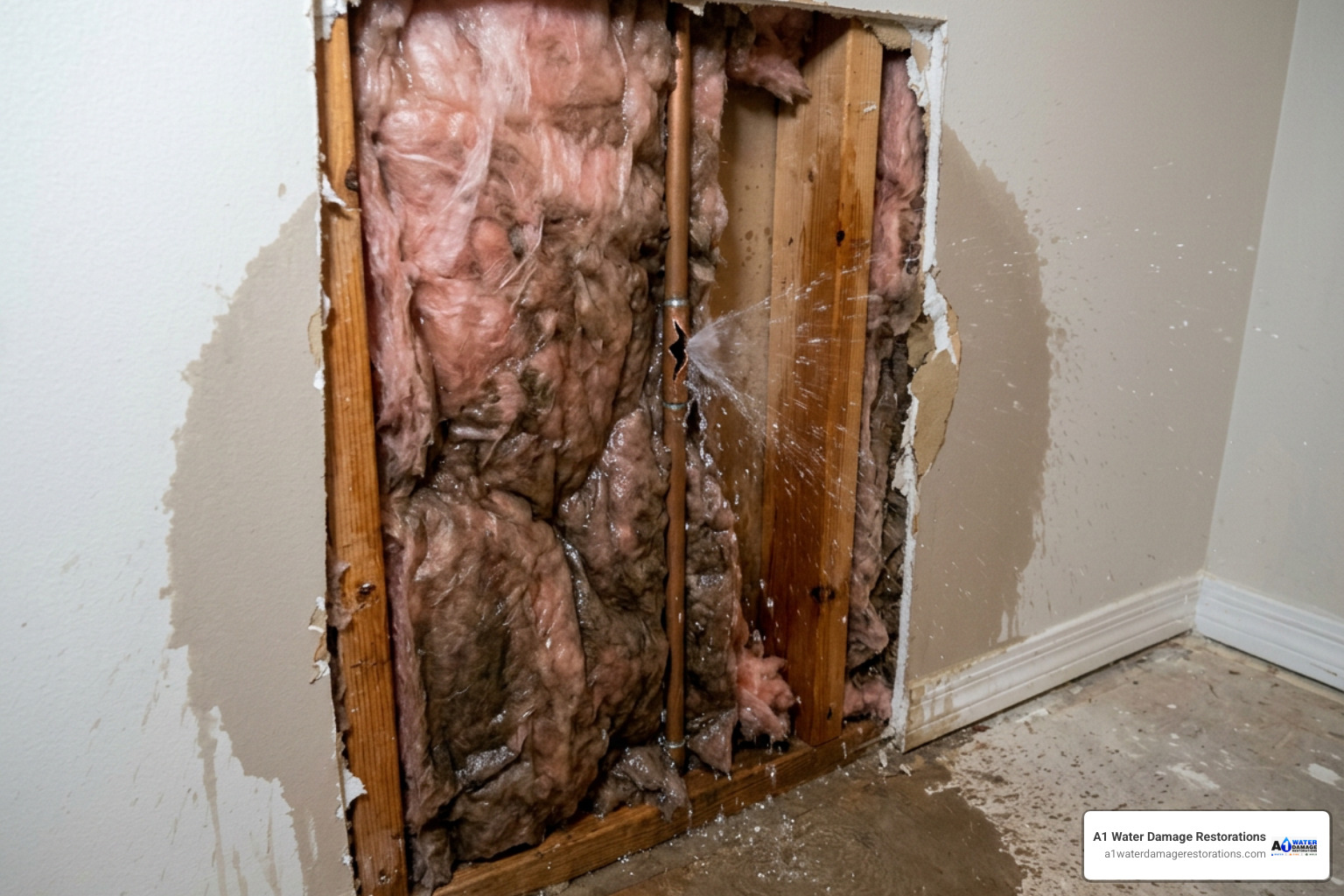
Plumbing is the classic grey area in multi-story buildings. A vertical main riser running inside a shared demising wall serves the entire stack of units; therefore, it is almost universally classified as a common element. When a main vertical drainage stack fails or a roof flashes improperly, the HOA’s property insurance and operating reserves must address both the root defect and resulting structural harm.
Conversely, supply lines running from the main shut-off valve exclusively to your private sink, toilet, or dishwasher are separate property. If you need clarity on how multi-unit building leaks are resolved between upstairs and downstairs neighbors, our guide on who pays when the ceiling leaks breaks down the specific steps for handling overhead water intrusion.
Neighbor Negligence and Upstairs Leaks
What happens when your upstairs neighbor falls asleep with the tub running, or neglects an ancient, visibly corroded water heater until it splits wide open?
When an owner fails to exercise reasonable care, they commit actionable negligence. Proximate cause rules dictate that the negligent party (or their personal liability carrier) is responsible for the downstream losses sustained by neighboring units and common hallways. However, if a modern stainless-steel braided supply line suddenly bursts without any prior warning or visible wear, the law often categorizes this as a non-negligent, accidental event. In that scenario, each owner must turn to their own insurance policy to repair their interior finishes.
Decoding Insurance: Master Policies vs. HO-6 Coverage
Navigating the financial recovery process requires coordinating your personal insurance with the association’s commercial coverage.
| Coverage Dimension | HOA Master Policy | Owner HO-6 Insurance Policy |
|---|---|---|
| Primary Scope | Building exterior, roof, shared mechanicals, hallways, bare structural framing | Interior drywall, paint, flooring, cabinetry, appliances, personal belongings |
| Deductibles | High ($5,000 to $50,000+), paid via HOA dues or assessed to at-fault owners | Moderate ($500 to $2,500), paid directly by the individual policyholder |
| Living Expenses | Does not cover individual relocation or temporary hotel accommodations | Includes Loss of Use coverage for temporary housing during repairs |
| Personal Liability | Covers common-area slip-and-falls and board fiduciary liabilities | Protects against claims if your unit’s leak causes third-party property damage |
Master Policy Types: Bare Walls vs. All-In
Not all master policies provide the same level of structural protection. Condo associations generally carry one of three distinct insurance structures:
- Bare Walls Coverage: The most basic commercial policy. It covers only the core structural components—exterior framing, concrete slabs, foundational masonry, and common utility chases. It leaves the interior drywall, subflooring, cabinetry, and fixtures entirely to the unit owner.
- Single Entity (Original Specifications): Covers the structural framing plus standard finishes and fixtures that were originally installed by the developer. It excludes custom upgrades installed by past or present owners.
- All-In (All-Inclusive): The most comprehensive policy. It covers all attached fixtures, built-in appliances, and structural improvements inside the unit, restoring the interior to its pre-loss state regardless of historical renovations.
Personal HO-6 Policies and Deductibles
Condominium owners need an individual HO-6 insurance policy. While your master policy secures the building envelope, your HO-6 covers interior dwelling improvements (Coverage A), personal property (Coverage C), and loss of use (Coverage D).
When catastrophic plumbing issues strike, you can review our emergency playbook on water damage woes when pipes burst to avoid costly claim missteps. If an HOA master policy responds to a major loss affecting your unit, the board may charge the association’s large master deductible back to you if the leak originated within your boundary lines. Carrying Loss Assessment Coverage on your HO-6 policy protects you from paying thousands out of pocket for these shared deductible assessments.
What Types of Condo Water Damage Are Excluded from Coverage?
Standard policies do not cover every water event. As explained in resources like Does Condo Insurance Cover Water Damage? | SoFi, standard property insurance applies strictly to sudden and accidental occurrences.
Key exclusions to watch for include:
- Gradual Seepage and Long-Term Leaks: Drips occurring over weeks or months are deemed maintenance failures and are denied.
- Sewer and Drain Backups: Raw sewage bubbling up through drains requires an explicit Water Backup & Sump Overflow Endorsement.
- Surface Floodwaters: Rising waters from outdoor flash floods or overflowing waterways require separate National Flood Insurance Program (NFIP) or private flood coverage.
- Wear and Tear / Mechanical Breakdown: Insurance pays for the resulting water damage, but rarely pays to replace the failed appliance or rusted pipe itself.
Legal Rights, Liens, and State Statutes
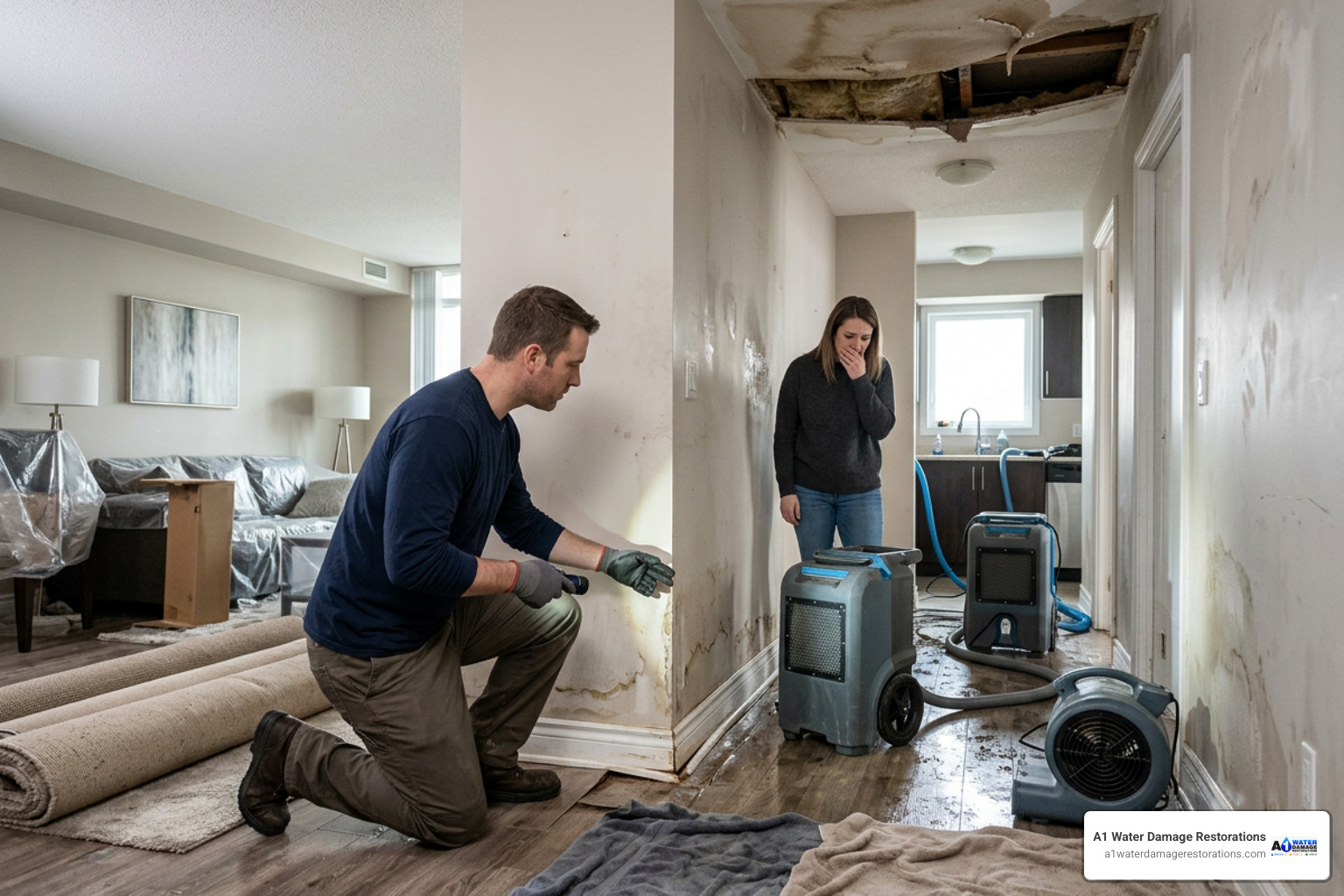
Condo boards carry a fiduciary duty to maintain the common areas. When an association fails to maintain a known roof failure or deteriorating plumbing stack, unit owners have strong statutory and common-law protections.
Statutory Obligations and Chapter 718 Insights
Condominium statutes throughout the country, such as the well-established framework analyzed by legal experts in Miami Condo Water Damage: When the Association Has to Repair Your Walls and Ceilings Under Chapter 718 – Corona Law Firm, P.A., establish strict guidelines governing association responsibilities. Under these statutory standards:
- Associations cannot arbitrarily dismiss common-element failures as “private disputes between neighbors.”
- If the association refuses to repair structural elements or common plumbing conduits, unit owners can pursue legal remedies to compel repairs and, where permitted by law, recover reasonable attorney fees.
- Associations are barred from holding unit owners strictly liable for damages unless clear negligence or willful misconduct is established.
HOA Repair Cost Assessments and Property Liens
When an HOA performs emergency remediation across multiple units, disputes often arise over how the invoice is split. Boards occasionally attempt to levy special assessments or file property liens against an individual owner’s deed to recover repair costs.
An association cannot lawfully enforce a property lien for common-element repairs unless the governing documents or state statutes expressly assign that financial obligation to the unit owner under established negligence rules. If a board attempts to assess costs unlawfully, owners have the right to challenge the assessment through formal dispute resolution procedures.
Action Plan: Resolving an Active Water Intrusion
When water enters your living space, prompt mitigation is your legal and contractual duty under every insurance policy. Following a disciplined, step-by-step sequence protects your property and legal position.
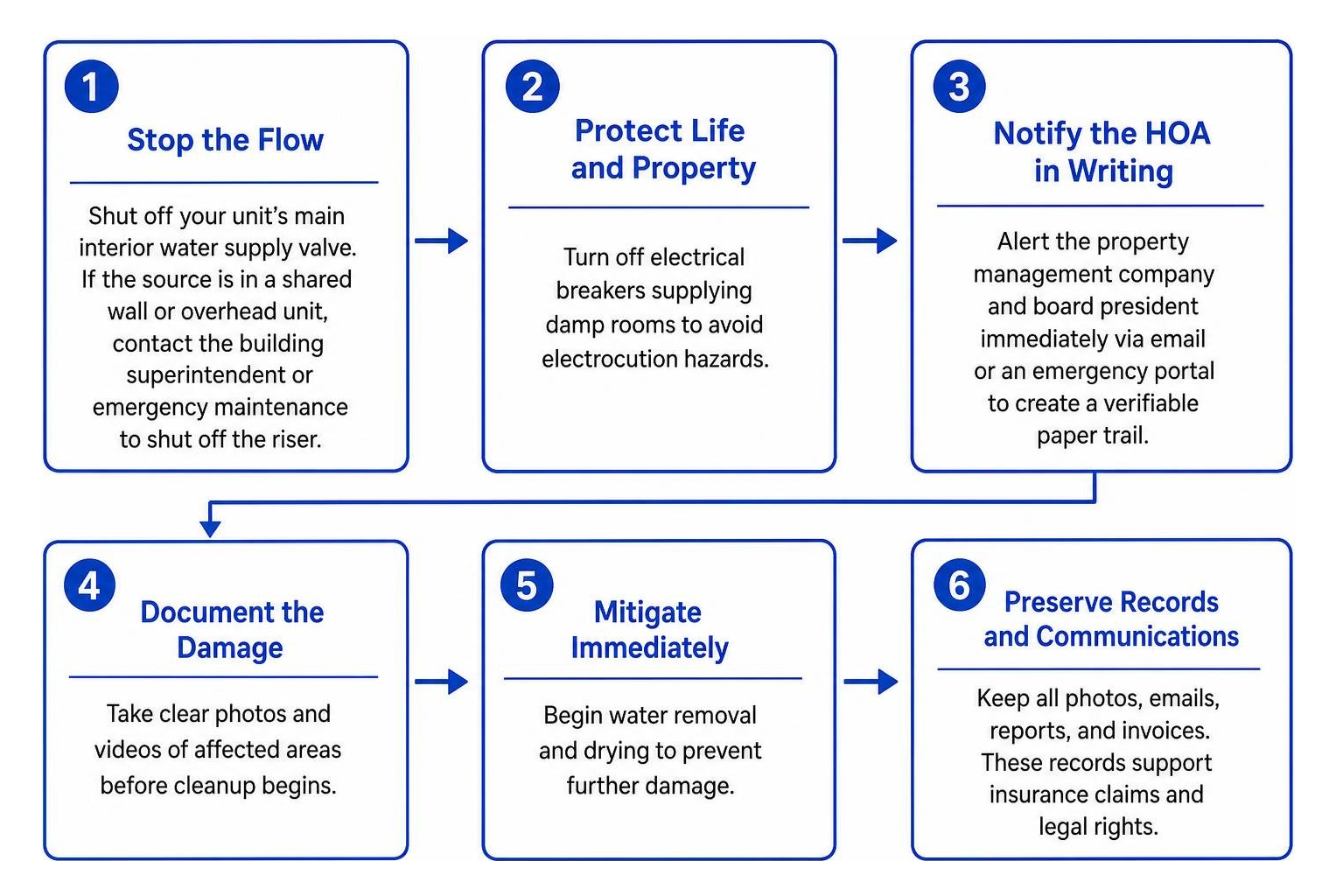
Immediate Steps to Take After Discovering Condo Water Damage
- Stop the Flow: Shut off your unit’s main interior water supply valve. If the source is in a shared wall or overhead unit, immediately contact the building superintendent or emergency maintenance to shut off the riser.
- Protect Life and Property: Turn off electrical breakers supplying damp rooms to avoid electrocution hazards.
- Notify the HOA in Writing: Alert the property management company and board president immediately via email or an emergency portal to create a verifiable paper trail.
- Document Every Detail: Capture comprehensive photos and wide-angle videos of pooling water, saturated drywall, ruined contents, and water entry points before moving items.
- Pinpoint Hidden Leaks: If the source is behind a wall or under a slab, utilize professional plumbing leak detection services to locate the failure without unnecessary demolition.
Professional Drying, Moisture Mapping, and Restoration
Household towels and consumer box fans cannot adequately dry multi-layered building assemblies. Water rapidly migrates beneath engineered hardwood, down into subflooring assemblies, and behind structural drywall.
Our IICRC-certified restoration crews deploy non-invasive thermal imaging cameras and commercial moisture meters to map moisture paths through shared wall cavities. Using industrial desiccant dehumidifiers and high-velocity air movers, we lower the relative humidity and extract bound moisture from building materials, preventing structural rot and toxic mold growth within the critical first 24 to 48 hours. When dealing with flooded carpets and subfloors, you can rely on proven methods like professional water extraction to rescue your foundational finishes.
Frequently Asked Questions About Condo Floods and HOA Responsibility
Is an HOA strictly liable if water enters my unit from a common element?
No. Condominium associations are generally not held to a standard of strict liability. To hold the HOA financially liable for personal property or interior finishes damaged by a common element (like a main drain or roof), you typically must establish that the association had prior notice of the defect and negligently failed to maintain or repair it in a reasonable timeframe.
Who pays the insurance deductible when a shared pipe bursts?
If the master policy responds to dry and rebuild structural areas, the master policy deductible is paid by the HOA as a common operational expense, unless the CC&Rs permit the board to assess the deductible directly to the unit where the failure began. If your personal HO-6 policy covers your interior finishes, you pay your own policy’s deductible.
What happens if my upstairs neighbor refuses to fix their leaking shower?
If a neighbor ignores an active leak, immediately notify HOA management in writing. Most condominium declarations grant the board emergency right-of-entry powers to enter any unit to repair leaks threatening the structural integrity of the property or adjacent homes. If damages continue, your insurance company can pay for your repairs and pursue a subrogation claim directly against the neighbor’s carrier.
Conclusion
Condominium water losses demand quick thinking, clear documentation, and a firm grasp of HOA bylaws and insurance contracts. By understanding the division between common elements and private property, securing robust HO-6 coverage with loss assessment riders, and acting swiftly during an intrusion, you can protect both your home and your financial interests.
When water strikes your property, our local, family-owned team at A1 Water Damage Restorations is ready around the clock with rapid 24/7 IICRC-certified mitigation, thermal moisture mapping, and complete reconstruction. Reach out to our team for comprehensive restoration services to restore your living space safely, cleanly, and completely.